Dead Outlet in Your Fairfax Home That Even the Reset Button Won't Fix
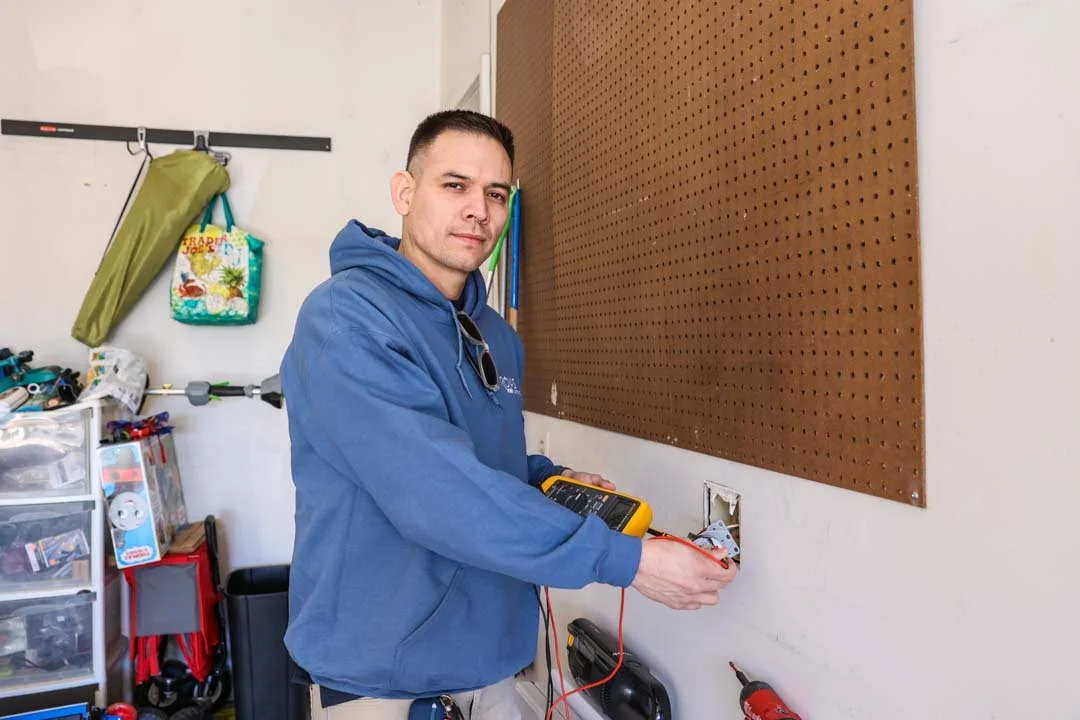
You found the dead outlet. You checked the breaker, and it is fine. You found the GFCI reset button in the bathroom down the hall and pressed it, and still nothing. You looked in every room for another GFCI that might be controlling this one and came up empty. The outlet is dead, the obvious explanations do not apply, and now you are wondering whether the problem is something inside the wall that you cannot see. In Fairfax, VA, homes of a certain age, that intuition is usually right. A dead outlet that is not explained by a tripped breaker or a GFCI that needs resetting is almost always telling you something about the wiring behind the device, and what it is telling you ranges from a simple loose connection to a failure somewhere in the daisy chain of outlets that share that circuit.
The daily inconvenience of a dead outlet is real, but it is the least important part of the problem. An outlet that has failed because of a loose connection, a wire that has separated from its terminal, or a wiring failure at a junction point is an outlet that has generated heat at the failure point before it stopped working. Connections that are loose or corroded generate resistance, and resistance under current flow generates heat. In many cases, the outlet stopped working because the heat at the failure point was enough to degrade the connection to the point of failure, not because anyone noticed anything was wrong. That is the version of the problem that warrants a prompt response rather than a plan to deal with it eventually.
How Daisy-Chain Wiring Creates Upstream Failures
Most residential circuits wire multiple outlets together in a series called a daisy chain. Power enters the first outlet in the chain through the panel circuit, continues from the first outlet to the second through wiring connections at the outlet terminals or at a junction box, and continues through each subsequent outlet to the end of the run. This means that a failure at any point in the chain affects every outlet downstream of the failure. If the connection at outlet number two in a five-outlet chain fails, outlets three, four, and five all lose power simultaneously, even though their own wiring connections are intact.
In Fairfax, VA, homes where the wiring dates from the 1970s or 1980s, daisy-chain wiring was often done using the back-stab connection method, where conductors are pushed into spring-clip terminals on the back of the outlet rather than secured under screw terminals on the sides. Back-stab connections are faster to install but have a well-documented tendency to loosen over time as the spring clip fatigues and as the outlet body expands and contracts through thermal cycling. A back-stabbed connection that has been in place for 40 years may have become intermittent years ago and failed completely more recently, taking everything downstream with it. When Rojas Electric diagnoses a dead outlet in a Fairfax, VA, home, checking the upstream outlets in the same circuit run for loose back-stab connections is always part of the diagnostic process, because fixing only the visible failure without checking the connections that led to it results in a call-back when the next one fails.
What Outlet Failure Actually Looks Like Inside the Box
When an electrician removes a dead outlet from its box to diagnose the failure, there are a few characteristic findings. The most common is a loose wire connection at the outlet terminal, either a wire that has backed out of a back-stab connector, a screw terminal that was not tightened adequately at installation, or a wire that has corroded at the connection point and lost reliable contact. Each of these produces a high-resistance connection that generates heat under load, and the heat discolors the outlet housing and sometimes scorches the wire insulation at the connection point. If the outlet body shows any darkening or the wire ends show any discoloration where they contact the terminal, the connection has been generating heat for some period before the final failure.
A less common but more serious finding is a wire that has separated not at the outlet terminal but at a junction point behind the wall, either at a wire nut connection in a junction box or at a splice point that was made without a proper box. Junction box failures are harder to diagnose because they are not visible at the outlet itself, and finding them requires tracing the circuit run to identify where the break is occurring. In Fairfax, VA, homes where outlets have been relocated or circuits have been modified over the decades, splices made inside walls without proper accessible junction boxes are more common than code-compliant work would produce, and tracking down those splices when they fail requires systematic circuit tracing rather than a simple outlet inspection.
When Outlet Repair Turns Into Outlet Replacement
A dead outlet that failed because of a loose connection at the terminal can sometimes be repaired by cleaning the connection and re-securing the wire under a screw terminal. In practice, outlets that have experienced heat damage at the connection point, outlets that are original to a home more than 25 years old, or outlets that have backstabbed connections are better replaced than repaired. An outlet body that has been subjected to localized heat may have internal damage to the plastic components that is not visible from outside but affects the integrity of the connection in the repaired configuration. Installing a new outlet with screw terminal connections costs a modest amount more than attempting to restore the old one and provides a connection that will not repeat the failure in the same way.
Outlet replacement also provides an opportunity to upgrade to a tamper-resistant outlet, which is the current code standard for all new outlet installations in habitable rooms. Tamper-resistant outlets have an internal shutter mechanism that prevents insertion of objects into a single slot, which is the consumer product safety improvement that replaced plug-in plastic covers as the standard approach to child-proofing outlets. If the dead outlet being replaced is in a room that was never updated to tamper-resistant devices, replacing it with a tamper-resistant outlet at the same time as the repair is a straightforward improvement that requires no additional work beyond the replacement itself.
Switch Failures and What Usually Causes Them
Switches fail less often than outlets because they carry lower current and are not subject to the resistive heating that outlet connections experience under appliance loads. When switches fail in Fairfax, VA, homes, the most common causes are mechanical failure of the switching mechanism after many years of use, back-stabbed connections that have loosened at the switch terminal, or a failed connection at a wire nut in the switch box. A switch that fails to turn on a light, that causes a light to flicker when touched, or that requires multiple presses before registering is a switch that has either a mechanical failure or a connection issue that produces inconsistent contact.
Diagnosing a switch failure starts at the switch itself: removing it from the box, checking the connections, and testing the switch mechanism with a continuity tester confirms whether the switch or the wiring is the problem. A switch that shows correct continuity when toggled but the light still does not work indicates a problem elsewhere in the circuit, either at the fixture itself, at a wire nut in the switch box, or at a junction point between the switch and the fixture. A switch that does not show continuity change when toggled has a failed internal mechanism and needs replacement. Switch replacement is one of the simpler electrical repairs, and because the wire connections in a switch box are less numerous than in an outlet box with a daisy chain, the diagnostic process is usually faster and the repair more contained.
FAQs
-
The most common reasons are a loose or failed connection at the outlet itself, a failed connection at an upstream outlet in the same daisy chain, or a tripped GFCI outlet elsewhere in the circuit that is controlling this outlet through its load terminals.
-
A dead outlet that shows no signs of heat damage, burning smell, or discoloration can be addressed on a non-emergency timeline in most cases. A dead outlet accompanied by a burning smell, visible scorch marks, or a warm outlet cover is a condition that warrants immediate attention because those signs indicate heat damage at a connection point that could progress to an arc fault or fire if the circuit remains in service.
-
Replacing a simple outlet at the same location with a new outlet of the same type is within reach of a capable DIYer with appropriate care about working on de-energized circuits. However, diagnosing why the outlet failed, tracing upstream daisy-chain connections to find the root cause, and identifying whether the failure involved heat damage that needs to be addressed beyond the visible outlet location requires the knowledge and tools that a licensed electrician brings to the work
-
GFCI outlets that protect downstream outlets through their load terminals are usually in the same general area of the home as the dead outlet. In a kitchen or bathroom, the GFCI is typically in the same room. For outlets in garage, outdoor, or basement locations, the controlling GFCI may be in the garage, at an outdoor location, or in the utility room.
-
Replacing all outlets at once is not strictly required, but it is often cost-effective when the home is already being evaluated for electrical issues. Outlets in a home more than 25 to 30 years old that still have back-stabbed connections throughout are at elevated risk for the same failure that caused the first dead outlet to present.