
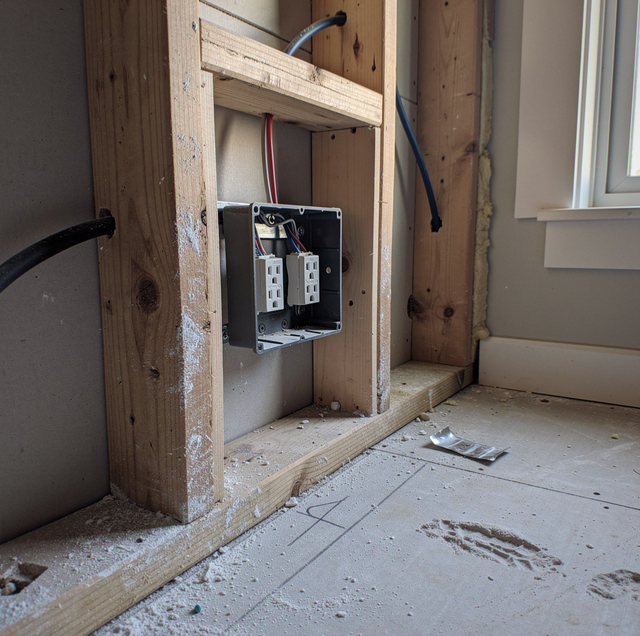
A wall-mounted TV needs two different things delivered to it, and hiding its wires safely comes down to keeping those two things on separate paths. Power has to arrive as building wiring, ending at a receptacle set into the wall behind the screen. The signal cables (HDMI, network cable, and antenna or cable-TV coax) carry low-voltage signals and run their own routes to wherever the media equipment sits. The TV's own power cord belongs on neither path. It is a flexible cord designed to remain exposed, where it can be seen, handled, and unplugged, not to run hidden inside a wall cavity.
Each item behind a mounted screen has a path it belongs on, and that path decides what keeps it safe:
| Item | Path it takes | What makes that path safe |
|---|---|---|
| The TV's power | A recessed receptacle behind the screen, fed as building wiring | Building cable in the cavity, with every connection inside a box |
| A soundbar's power | The second outlet of the recessed receptacle behind the screen | Its cord plugs in at the wall face and hangs in the open |
| A media device's power | The receptacle at the media cabinet | Plug-in cords stay in the room, in plain view |
| HDMI | A low-voltage pass-through plate at each end, with a conduit or raceway between the TV and the cabinet | It stays out of any box or opening power uses unless a divider separates the two |
| Network cable | The same low-voltage plates and conduit as the HDMI | It rides the signal path, away from power cable |
| Antenna or coax | The same low-voltage path | It enters and leaves the wall through the pass-through plates |
| A surge-protected strip | Plugged into the cabinet receptacle | It sits out in the room beside the equipment it feeds |
Why the Power Cord Stays Outside the Wall and What Replaces It
A flexible cord is built for a life in the open. Its jacket is designed to bend and be handled, and its safety depends on being visible, so a nick, a crushed spot, or a plug that runs hot gets noticed. Inside a cavity, a cord pinched by a drywall screw, a staple, or the rough edge of a bored hole can be damaged with no sign on the outside, and a plug hidden in the wall is a connection nobody can check. Extension cords and power strips pushed through a wall carry the same problem plus one more: their outlets end up buried where a loose plug can heat up out of sight, so neither one is ever run through a wall.
What goes in the cord's place is building wiring. Power is extended from an existing circuit to a new receptacle behind the screen, with building cable running inside the wall and ending in a box at each end, so every connection sits inside an enclosure. Power inside a wall has to be installed as wiring, and the electrician handles any permit the job needs. Splicing into the house wiring behind the TV is part of that electrical work, since a splice made outside a box or left under drywall is a hidden fault waiting to heat up.
The receptacle behind the TV goes in a recessed box. A recessed box sets the outlet face back behind the wall surface, so the plug and the first stretch of cord fit inside the gap between the wall and the back of the screen instead of pushing the TV forward or bending the cord hard against the drywall.
In-wall power kit: A second route pairs two plates. The upper plate sits behind the screen and holds an outlet; the lower plate sits near the floor and holds a power inlet. The cable runs inside the wall to join the two, and a short cord from the lower inlet plugs into an existing receptacle below it. The part inside the wall is still wiring, with its connections enclosed at both ends, and the plug-in cord stays outside the wall. Which route fits a given wall depends on where the nearest circuit runs.
Low-Voltage Cables and Keeping Them Apart from Power
Signal cables belong to a different class of wiring. HDMI, network cable, and coax carry low voltage and very little current, so they do not need a closed box at the wall. They pass through a low-voltage bracket instead: an open-backed frame that clamps to the drywall and takes a cover plate with a brush insert or a wide opening. Because that bracket has no back and no enclosure, it provides no protection for power wiring, and power conductors do not pass through it.
Inside the cavity, the two classes stay apart. Signal cables are not tied to power cable, not pulled through the same bored hole, and not brought into the same box unless that box has a built-in divider holding each class on its own side. A combination plate built that way places the receptacle and the low-voltage opening in a single cutout, with a barrier between them.
The separation is protective first. A power cable that is nicked or overheating can put line voltage onto a signal cable whose insulation was never meant to withstand it, and from there onto the TV's ports and every device connected to them. Where HDMI or network cable runs right alongside a power cable for a long stretch, current in the power cable can induce noise into the signal; where the two have to meet, crossing at a right angle keeps the shared length short.
A Conduit Between the TV and the Media Cabinet
Signal cables fished bare through a wall stay wherever they land, and replacing one can mean fishing a new cable past the framing again. Flexible non-metallic tubing run inside the wall from the TV location to the cabinet gives the signal cables a sleeve they can be pulled into and pulled back out of. A failed HDMI cable, a new video standard that calls for a different cable, or a second network line becomes a pull through the conduit rather than a wall repair.
Each bend adds friction to that pull, so the run is laid out with wide sweeps and as few turns as the framing allows, and each end finishes at a low-voltage bracket. The conduit carries signal cables only. Power keeps its own building cable and its own boxes.
When the Wall Cannot Be Opened
Some walls are not candidates for an in-wall run. Brick, stone, a fireplace surround, or a cavity packed with pipes leaves no clear path. A surface raceway takes over in those cases: a low-voltage channel on the wall face for the signal cables, and a raceway made for building wiring when a receptacle has to be extended up the wall. The power inside it is still wiring rather than a cord.
What Is Inside the Wall Before Anyone Cuts
A wall that looks empty from the room side can hold several things that would otherwise block a cable run.
Studs: Standard wood framing sets studs at 16- or 24-inch centers. A run that stays within one stud bay is a vertical drop; a run that crosses to the next bay means boring through each stud in the way, or routing up through the attic or down through the floor.
Fire blocking: Some walls have a horizontal block of lumber between the studs partway up, which stops a fish tape cold. A hole bored through it for cables is sealed afterward, so the block keeps slowing fire and smoke from passing through the cavity.
Existing wiring: A receptacle or switch near the planned spot can mean a power cable already runs through that cavity or the one beside it, between boxes or up to a switch.
Plumbing and gas: A wall backing a bathroom or kitchen can hold supply lines, drains or a vent stack, and a wall near a gas fireplace can hold its gas line.
Insulation in an outside wall: Batts fill the cavity from side to side, grab at a fish tape, and have a facing that tears when a cable is dragged through.
The sequence on the electrician's side is fixed: the circuit feeding any nearby receptacle or switch is turned off at the panel first, and then the cavity is checked through a small inspection opening before the full cutout is made.
A drill bit or saw blade that meets a live cable behind drywall can carry line voltage through the tool to the hand. That cable can belong to a circuit other than the nearest outlet's, which the electrician tests for before cutting.
Planning the Screen and the Cabinet Before the Wall Opens
The screen's position comes first because the recessed receptacle and the low-voltage plate must land within the screen's outline once it is mounted and be clear of the mount's wall plate. Openings cut before that decision is final can end up exposed below the screen or blocked by the mount's bracket, and moving them means patching the first holes.
Blue painter's tape marking the screen's four edges makes the plan visible from the couch, so the height and centering can be judged from the seating before any opening is cut in the drywall.
A fixed mount holds the screen close to the wall, which is where the recessed box earns its place; an articulating arm swings the screen out, so its cords need slack for full extension.
The cabinet's location decides the conduit route. A cabinet directly below the TV in the same stud bay keeps the conduit to one vertical drop. A cabinet off to one side means a horizontal run bored through the studs between the two, or a route that drops through the floor and comes back up from a basement or crawlspace, or one that goes up through an attic. The cabinet also needs a receptacle of its own for the media devices, and a surge-protected strip there guards the electronics plugged into it, while panel-level surge protection covers the circuits beyond it.
Frequently Asked Questions
It fits when the conduit is sized for the plug rather than the cable. The connector head is wider and thicker than the cable behind it, so the tubing's inside diameter has to pass the head with room to spare, and a size up leaves space for a second cable to follow later. A pull string left inside the conduit after the first cables are run gives the next cable something to tie to.
A standard passive HDMI cable loses signal over length, and a long run can show sparkles, blackouts, or no picture at all. Long in-wall runs can use an active or fiber-optic HDMI cable, which boosts or converts the signal along the way. Those cables are directional: one end is marked for the source and the other for the display, and installed backward, they pass no picture.
It can share one. A TV and a soundbar draw only a small fraction of what a microwave or a space heater draws, so the receptacle behind the screen can be extended from a nearby general-purpose circuit with room to spare. Whether a circuit has that room depends on what it already feeds, and a circuit that already trips its breaker is not one to extend.
Every opening cut into an exterior wall's drywall is a path for outside air into the room. A recessed box with a foam gasket behind its cover and a seal around the low-voltage bracket closes that path, so the TV location does not become a draft point on a cold or hot day.
A box that holds wire connections stays accessible, so an abandoned receptacle behind the old TV spot keeps its blank cover plate rather than being drywalled over. The low-voltage openings are simpler: once the signal cables are pulled out, the bracket can come out, and the hole can be patched and painted.
Yes, but infrared remotes need line of sight to the device they control. Equipment behind a closed door or in another room needs an IR repeater, with a small receiver near the TV and emitters on the devices, or remotes that work over radio or the home network. The conduit then runs to that closet instead of to a cabinet under the screen.
Set up concealed TV wiring for your wall-mounted TV — a recessed receptacle behind the screen and low-voltage runs to the media cabinet. Rojas Electric serves Fairfax and all of Northern Virginia. Call (703) 810-3693.