
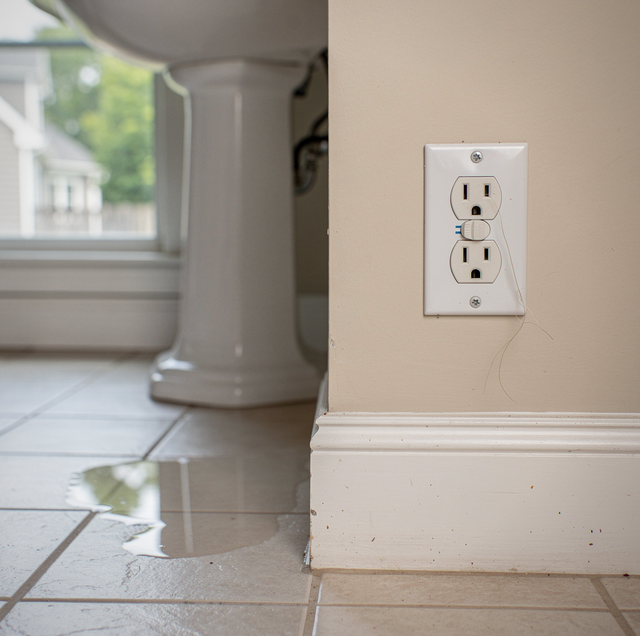
You press reset, the button clicks in, and the bathroom outlet comes back to life. An hour later, or the second the hair dryer starts, it is dead again. Before you blame the outlet, note when the trips happen, because the device does one narrow job and the timing of each trip points to what set it off.
A ground-fault circuit interrupter measures the current leaving the hot conductor and the current returning on the neutral. On a healthy circuit, those two numbers match. When some of the current fails to return, it finds another path to ground: through damp insulation, a wet box, a failing appliance, or a person. Once the gap reaches roughly 4 to 6 milliamps, a few thousandths of an amp, the device cuts power within a fraction of a second.
How a GFCI Decides to Trip
Inside the device, both conductors pass through a small sensing coil. Equal currents flowing in opposite directions cancel, so the coil registers nothing. Any imbalance leaves a small magnetic field the coil picks up, and the electronics release a spring-loaded switch that opens the circuit.
The GFCI cannot identify the leak path: a person touching a live part and a sump pump with damp motor windings look identical to it. It also ignores how much current the circuit carries. A heavy load that stays balanced never trips it; the breaker's job is to guard the wire against too much current. A trip reports a leak, and the work is finding where.
One GFCI also protects every outlet wired to its load side, so the leak can sit at an outlet or appliance in another room and still trip the device you are standing in front of.
| When it trips | What it points to | Your safe step |
|---|---|---|
| The instant you press reset | A constant leak in the wiring or the device | Unplug everything it protects and reset once |
| When one appliance runs | That appliance leaking current, or leakage stacking on the circuit | Plug loads back in one at a time |
| After rain or in a steamy room | Water inside an outdoor or bath box | Leave it off until the box is dry and inspected |
| With no pattern you can see | A self-starting load or a worn device | Log each trip with time, weather, and what was running |
It Trips the Moment You Reset It
A GFCI that snaps off the instant you press reset, or refuses to latch at all, is facing a leak that is present all the time. Start with the one test you can safely run: unplug everything from the GFCI and from any outlets it protects, then press reset once. If it holds, something you unplugged is the source. If it trips again with nothing plugged in anywhere, the leak is in the fixed wiring or the device, and your part of the job is done.
In the wiring, a nail or screw driven through a cable while hanging a shelf can press the hot conductor against the bare ground wire. A neutral touching bare ground downstream sends part of the return current home on the ground path, which the GFCI reads as a leak. And a load-side neutral joined to the neutral of a different circuit carries return current the GFCI never saw leave. Tripping that began right after nearby wall work points at the first; tripping since the day the device went in points at the other two.
Swapping a tripping GFCI for a standard outlet, or rewiring around it, leaves the leak energized and strips shock protection from every outlet it covered. A licensed electrician locates the fault instead, working with the circuit shut off at the panel.
It Trips When One Appliance Runs
If the GFCI holds with everything unplugged, plug appliances back in one at a time and run each for a few minutes. The one that trips has a leak of its own. Suspect anything built around a heating element or motor, since both rely on thin insulation to keep a live part away from a metal case: hair dryers, space heaters, washing machines, dishwashers, sump pumps, pressure washers, and power tools with a worn cord. Heat, vibration, and age wear that insulation, and a small leak through it crosses a threshold measured in thousandths of an amp.
Try the suspect on a GFCI-protected outlet elsewhere in the house. If it trips that one too, the appliance needs repair or replacement; a new outlet changes nothing. If it runs fine elsewhere and trips only on this circuit, the appliance may be adding a small leak on top of leakage already present there.
Leakage adds up. A GFCI protecting a long run of outlets sees the combined leak of every device along it, including power strips with surge or noise filtering, whose filter parts pass a tiny current to ground by design, plus a trace from the cable itself. Each piece stays under the trip point, and the total crosses it when one more load switches on. Splitting a long protected run between GFCIs ends the stacking, which is wiring work for an electrician.
It Trips After Rain or in a Damp Room
Water conducts well enough to provide a path for current from a hot terminal to a grounded box, and a damp GFCI trips on that path the same way it trips on a person. After a storm, start with outdoor outlets under a flat cover that only seals when nothing is plugged in; with a cord in place, it remains open to rain. An in-use cover, the deep bubble style, closes over a plugged-in cord. Water also enters from behind, through a box that lost its gasket or conduit that carries water down into it.
Indoors, the same leak is caused by condensation. A bathroom with a weak or missing exhaust fan fills with steam that settles inside a cool outlet box, and an unheated garage or basement collects moisture on metal boxes when humid air meets a cold wall. Summer humidity and winter condensation can each put water in a box, so a wet-weather trip says something about the box, not the season. Cord connections count too: an extension cord joint lying in wet grass, holiday lights, or a fountain pump.
A GFCI that trips in wet weather and resets once things dry out has not fixed itself. Each wetting can leave mineral residue and corrosion on the terminals, ready to carry current the next time moisture arrives. The repair belongs in one of the following: an in-use cover, a weather-resistant device marked WR, a resealed or relocated box, or a working bathroom fan.
It Trips at Random
Trips with no obvious trigger come from two directions. The first is a load that switches itself on. A sump pump cycles when water rises, a freezer runs its compressor and defrost cycle on its own schedule, and a dehumidifier starts when the air gets damp. If one of them has a small leak, the GFCI trips while you are asleep or away, and the trip looks random because no one saw the load start.
Keep a short log beside the outlet: the date, the time you found it tripped, the weather, and what was running. A handful of entries can reveal a pump cycle, a wet night, or no link at all.
The second is the device itself. A GFCI is an electronic sensor with a mechanical switch attached. Voltage surges, heat inside a crowded box, and years of service wear both, and a damaged device can trip on the electrical noise a motor makes as it starts. If trips continue with every load unplugged and dry weather, a worn device or an intermittent wiring fault is what remains. Telling those apart takes test equipment, and that is the point to stop troubleshooting.
Why a GFCI That Never Trips Is the Bigger Problem
Every trip so far is the GFCI doing its work. The failure worth worrying about is silent: a device whose sensor or switch has died with the power still on. The outlet keeps working, and the protection is gone. Early GFCI designs could fail this way with no outward sign, and a device that has sat in a damp exterior box or taken a surge is a candidate at any age.
The test button is how you find out. Pressing it routes a small, deliberate imbalance through an internal resistor. A working GFCI cuts power at once, and the reset button pops out. If you press test and nothing happens, or the button pops, but the outlet still has power, the device is not protecting that circuit. Leave it unused until an electrician replaces it.
One wiring error hides behind a test button that seems to work. When incoming power is connected to the terminals intended for the downstream outlets, some early devices still click off on test, cutting the downstream outlets while their own two slots remain live and unprotected. Current designs refuse to reset when wired that way, so a brand-new GFCI that will not reset deserves a wiring check before anyone calls it defective.
When to Call an Electrician
Bring in a licensed electrician when:
- it trips the instant you reset it with nothing plugged in anywhere on the circuit;
- it trips in wet weather or in a steamy bathroom, and the box or cover is the likely way in;
- the trips continue with every load unplugged;
- the test button does nothing, or the outlet stays live after the button pops;
- the reset button will not latch at all;
- you see scorching, hear buzzing, or feel heat at the device.
Bring the pattern with you. The time of each trip, what was running, the weather, and which outlets went dead with it let an electrician test the right stretch of wiring first instead of opening every box on the run. The repair can be as small as a new cover or as involved as tracing a damaged cable inside a wall, and the scope narrows depending on which one you face.
Frequently Asked Questions
No. It compares only the hot and neutral currents, so it protects people on an old two-wire circuit with no ground conductor, and the outlets it protects are normally marked to show they have no equipment ground. One catch: a plug-in outlet tester with a GFCI button needs a ground wire to create its test leak, so on an ungrounded circuit it cannot trip the device.
Yes. A GFCI breaker provides the same protection for an entire circuit from the panel and has its own test button on the breaker face. When one trips, the handle moves to the tripped position like any breaker, and there is no reset button on the wall. If the outlets in a bathroom or garage have no buttons, look in the panel for a breaker with a test button.
No. Current that passes through you from hot to neutral still returns on the neutral, so the two readings stay equal and the device sees nothing wrong. A GFCI only reacts to current that escapes to ground, such as through your body to a wet floor or a grounded pipe. That gap is one reason no one should work inside a live box even when a GFCI protects it.
Test the outlet once a month. Plug a lamp or night light into the outlet and switch it on before pressing test, so you can see the power drop rather than relying on the button alone. Then press reset and confirm the lamp comes back on. Check downstream outlets the same way by moving the lamp to one of them.
Sheathed heating elements in ovens, dishwashers, and kettles insulate the coil from the metal tube with packed magnesium oxide powder. That powder draws moisture from the air while the appliance sits idle, and the damp insulation leaks current until the element heats up and drives the moisture out. An appliance technician can confirm whether the element needs replacing.
It depends on the model, so check the device face or its instructions. Current designs run an automatic self-test on their own sensing circuit, and some of them report the result with a light. Some models show green for power; a red or flashing light, where a device has one, signals that the self-test found a fault and the device needs to be replaced.
Book a GFCI trip diagnosis — describe when the outlet trips and a licensed electrician traces the leak to its wire, box, device or appliance without bypassing the protection. Rojas Electric serves Fairfax and all of Northern Virginia. Call (703) 810-3693.