
How a Smart Panel Decides Which Circuits Survive an Outage
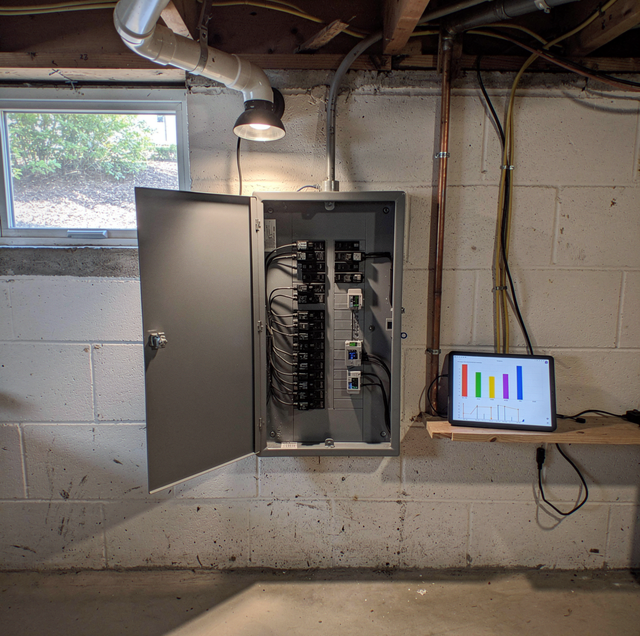
Every Branch Circuit Reports Its Own Draw
A standard load center knows one number: the current passing through the main breaker. It has no idea whether the current is from the refrigerator, the dryer, the water heater, or a space heater running together. The breaker protects the wire behind it and nothing else; it has no way to single out one circuit from another, so it has no way to prioritize between them either.
A smart panel senses at the hardware level. Each branch position carries its own current sensor, typically a small current transformer or shunt mounted right at the breaker, and that sensor continuously reports real amperage to a central controller, refreshed many times a second rather than only when something changes. The panel reads what each circuit is actually drawing right now, separately from every other circuit in the box, rather than estimating a draw based on the breaker's size. A panel that can't see individual circuits has nothing to ration. That same sensing feed also lets an app on your phone or tablet show which circuit is drawing power at any given moment, long before an outage ever puts the system to work.
The Real Ceiling Is Whatever the Battery or Generator Can Deliver Right Now
During an outage, the panel manages against whatever backup source is actually connected, not your home's normal service capacity, and that source carries two different numbers. A battery inverter has a continuous output rating, the load it can sustain indefinitely, and a separate surge rating, a higher figure it can hold only briefly. A generator has its own continuous running wattage, tied to engine size and fuel delivery rather than to a battery's chemistry. Either way, that number is the real ceiling the panel manages against.
A generator's ceiling during an outage comes from its continuous wattage rating on the spec plate, a separate, smaller number than the surge or peak rating printed beside it. Check that continuous figure before assuming a generator can carry your tier list.
That ceiling also isn't fixed for the length of the outage. A battery's remaining reserve falls through the night as circuits draw on it with no solar recharge to offset the draw, and as state of charge drops, the amount of power the inverter can responsibly sustain steps down with it. A generator's ceiling holds steadier, but only as long as the fuel does, and an undersized unit hits its ceiling early regardless of what your priority list asks for. How the backup source physically connects to the panel, whether through an interlock kit or a transfer switch, is a separate question with its own safety rules; what matters here is only the number it hands the panel to work against.
Priority Tiers Set the Order; the Falling Ceiling Sets How Far It Goes
At commissioning, you assign every circuit to a tier: refrigerator and sump pump near the top, a home office and a few lights in the middle, a pool pump or a second refrigerator further down. You've already decided what matters by setting those tiers. What the panel does, continuously, is total the running draw of everything currently on and compare that sum against the backup source's current ceiling.
When the total gets close to the ceiling, the panel sheds from the bottom of your list first, dropping the lowest tier before touching anything above it, and keeps dropping tiers for as long as the total still exceeds what's available. A battery bank that starts an outage and can run every assigned tier may, several hours in, no longer be able to support everything it started with, simply because the ceiling itself came down, since the arithmetic runs against your fixed tier list, changing by the hour.
A Compressor's Starting Surge Can Fail a Circuit Whose Running Draw Never Would
This is the part that can catch you off guard. A motor, whether it's driving a well pump, an air conditioner's compressor, or a pool pump, pulls far more current for a fraction of a second at startup than it pulls once it's running. That inrush current, sometimes several times the running amperage, is a normal characteristic of induction motors.
A panel managing a fixed backup source has to protect against exceeding both the surge and continuous ceilings, and that surge headroom is shared across everything already drawing power. A well pump can sit comfortably within its assigned tier, with the running draw well under budget, and still be denied a start if firing it up right now would exceed the surge limit, especially with other loads already eating into that momentary headroom. You might see a pump that's on the priority list refuse to turn on and assume something's broken. Starting a motor and running it are two different arithmetic problems, and the panel is solving both at once. A backup system sized with headroom to spare absorbs that instant without incident; one sized to just barely cover your home's steady draw has almost nothing left over for it, which is part of why sizing a battery or generator is about more than adding up everyday wattage.
Forcing a shed or locked-out circuit back on manually during an outage isn't risk-free. If the surge headroom truly isn't there, the load will most likely trip the inverter's own overcurrent protection, and in rare cases put stress on its internal components.
Some Shed Circuits Return on Their Own; Others Wait for a Person
A circuit the panel drops for capacity reasons is not the same event as a circuit that trips on a fault, and the two look identical from the kitchen. Load shedding is the panel reacting to a ceiling; nothing is wrong with the circuit itself, and once headroom returns, whether the generator ramps up or a higher-tier load finishes its cycle and switches off, a shed circuit typically re-energizes on its own with no visit to your panel required.
A circuit that trips its breaker is a different mechanism answering a different question. That's the breaker responding to an overcurrent condition it's rated to handle, protecting the wire behind it from heat it wasn't sized to carry, and it stays open until you reset it. The panel's capacity logic asks whether the source can handle this load right now; the breaker's protective trip asks whether the wire is in danger. Only the first of those clears itself.
The Priority List Is a Decision, and It Doesn't Update Itself
Every tier assignment gets made once, usually in a single conversation at install, before you've lived through an outage long enough to learn what actually mattered. A chest freezer that seemed skippable in that conversation could be carrying a season of meat by the time it matters. A home office that didn't exist yet at commissioning might now be where your paycheck depends on staying connected.
The list doesn't update itself as your household changes. A new appliance, a converted room, or a second EV in your driveway can sit outside the tiers you set years earlier, quietly, until an outage exposes the gap between what was assigned and what your house actually needs now. By the time that gap shows up, the freezer is already thawing, and you have no menu open to fix it in the moment. A natural point to revisit the list is whenever a circuit's actual use changes: a garage that becomes a workshop, a spare bedroom that becomes a nursery running a sound machine and a mini fridge around the clock. Each of those swaps changes what the panel protects, even though nothing in the tier list itself flags the change.
Frequently Asked Questions
The battery's own management system tracks the state of charge internally and reports it to the inverter over a data connection, often the same link used to control charging. The panel's ceiling number comes from that report.
Many smart panel apps let you force a lower-tier circuit back on temporarily. That override typically only applies to the current session; the next time the panel needs to shed load, it reverts to the tiers you programmed at commissioning rather than retaining your manual change.
Many smart panels stagger the reconnection of larger loads once the ceiling rises again, bringing shed circuits back one at a time. That sequencing keeps several startup surges from stacking into a single moment and tripping the same limit the panel just spent hours managing around.
A circuit drawing current well outside its normal pattern is generally flagged as a possible fault, separate from ordinary load-shedding math. Many panel apps log the two differently, so an anomalous spike shows up in your history as something distinct from a routine tier drop.
Only circuits actually landed in the smart panel itself get individually sensed and tiered. A subpanel fed from it without its own current sensors, such as one serving a detached garage or a finished basement, behaves as a single large circuit in your priority list.
Some smart panel apps include a test or simulation mode that lets you briefly disconnect from utility power on purpose and watch the shedding order play out in real time. That's the only way to confirm your tier assignments behave as intended before an actual outage forces the question.
Get your smart panel's priority list reviewed — Rojas Electric's certified Span technicians can check whether your tier assignments still match how your home actually uses power today. Rojas Electric serves Fairfax and all of Northern Virginia. Call (703) 810-3693.
