
Charging Two EVs in McLean Without Overloading Your Panel
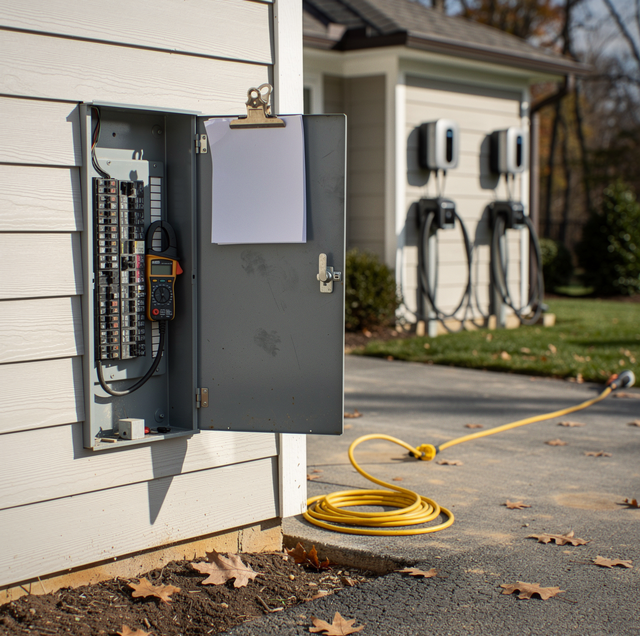
The second electric car shows up in your driveway, and the thing that changes first is not your parking; it is your panel. Your first charger has pulled its 40 amps overnight for a year without complaint, and now a second one wants the same amperage from the service you already own. Two Level 2 chargers running together are not two small additions to your house, and you should not expect your panel to treat them that way. They are one large load that lands at the same hour every night, on top of whatever else you left running. What follows is how your second charger gets fed, what an electrician measures before you buy either unit, and where your own honest ceiling actually sits.
What the Second Charger Asks of Your Panel
A Level 2 charger is a continuous load, trade shorthand for a device that draws close to full current for hours without pausing. A clothes dryer heats, coasts, and heats again. A charger does not. The circuit feeding one is sized above the current it actually pulls rather than exactly to it, which is why a 40-amp charger sits on a 50-amp circuit and a 48-amp charger on a 60-amp one.
Your panel has no opinion about what a load is attached to. The main breaker and the bus behind it see the total of everything drawing at that moment, so your second charger becomes a problem only in the hours when it overlaps with the heat pump, the water heater, the range, and the car you plugged in first.
Why Two Chargers Cannot Simply Share One Circuit
Every Level 2 charger needs its own dedicated 240-volt circuit. That is not a preference, and it is not a corner an electrician cuts to save wire. Two chargers landed on one circuit with nothing coordinating them; both draw their full current the moment both cars plug in, and the breaker is protecting the conductor, not the cars. It responds to the sum. Either it trips every night at nine, or, if somebody has swapped it for a larger one, it stops responding altogether while the wire behind your drywall keeps heating up.
The second outcome is the dangerous one, because nothing about it is visible from the kitchen. The circuit works. The cars charge. The failure builds inside a wall cavity where you have no way to see it, and nothing reaches you until the damage is already done.
Fitting a larger breaker to existing conductors so two chargers fit can overheat wiring inside walls and start a fire, so always leave breaker sizing to a licensed electrician.
How Power Sharing Divides One Feed Between Two Chargers
There is a coordinated version of one circuit feeding two chargers, and it works because the chargers talk to each other before the breaker ever has to. Tesla calls its version Group Power Management: it allows up to six Gen 3 Wall Connectors to share power and charge multiple vehicles at once, distributing power to minimize each vehicle's charge time while keeping the total drawn from the panel or a single circuit within safe limits. The units monitor and control that total wirelessly. All Gen 3 variants are compatible with one another inside the same group, so a household running two different Wall Connector versions is still one group.
The limit that catches people is a brand-level one. Group Power Management works only between Gen 3 Wall Connectors, and mixing makers quietly ends the arrangement for your second car.
Other makers run their own version inside their line: Emporia offers Intelligent Load Sharing for two or more of its chargers, so you match brands before you buy. The working shape of a real group is easy enough to picture from the driveway. One car plugged in alone takes the full output the circuit allows. The moment the second arrives, both step down to a share of the same feed, nothing switches off, and nobody queues in the garage. What you are living with is a ceiling. The feed is whatever your electrician was able to give it, and both of your cars spend the night underneath that one number together. Most weeks you will not notice the difference at all.
Fixed Limits, Live Limits, and the Meter Between Them
Sharing between chargers is one of three ways output gets held down, and the other two are worth knowing because an electrician will name them on the phone with you. The simplest is a fixed limit chosen at installation. Tesla's Static Power Management lets the installer pick a power level that suits the panel, and that maximum then stays constant and does not adjust for any reason at all.
The livelier option watches the house. Tesla's Dynamic Power Management uses an approved power meter to track how much of your panel is actually free, and it adjusts the rate as the dryer and the oven come and go. Its catch matters for your situation: Tesla limits that mode to single Wall Connector installations, and it cannot be used across multiple Wall Connectors, so a two-charger household like yours is back to the group.
Is Divided Amperage Enough to Fill Two Cars Overnight?
The arithmetic is where this gets reassuring. A Level 2 charger adds 25 to 40 miles of range per hour, compared to the 3 to 5 miles per hour a standard 120-volt outlet provides, and most vehicles fill in 4 to 8 hours on a dedicated 240-volt circuit.
Halve that for the hours both of your cars are drawing, and each one still gains a dozen or more miles every hour you leave it there. Across a ten-hour night that is a working week of ordinary commuting for two drivers, delivered while nobody is awake. The question was never whether a shared feed can fill both batteries by morning. It is whether the feed replaces what the two of you actually drove that day, and for most households, yours very likely included, the honest answer is yes with room left over.
The Load Calculation That Comes Before Either Charger
Before any of this gets chosen, an electrician adds up what your service already carries. The calculation takes the rating of the service, the fixed loads inside the house, the rating of the panel bus itself, and the two chargers as the continuous loads they are. It happens on paper, during a phone assessment or a visit, and it happens before equipment is ordered, well ahead of any pallet arriving in your driveway.
Counting empty breaker spaces is a different question, and confusing the two is the most common way you talk yourself into the wrong project. A panel can have four open spaces and no amperage left to give, and it can equally be full of breakers while the service behind it has plenty of headroom.
Opening a panel cover to count spare slots puts your hands within reach of energized bus bars that stay live even with the main breaker switched off, so the capacity question belongs to a licensed electrician with the meter and training.
What comes back is a number with a recommendation attached: two independent circuits, one shared feed with both chargers dialed to a figure the service can carry, or simply more service.
When a Panel Upgrade Is the Answer and When It Is Not
An upgrade is not the automatic answer to adding a second car. Plenty of homes absorb one by sharing a feed, by lowering the output each charger is allowed to take, or by charging the two cars on staggered schedules that never overlap, and yours may well be one of them. The one-charger version of that question, whether a single charger fits without an upgrade at all, is a separate subject with a separate answer.
When the calculation comes back short, the upgrade and the charger belong in one project rather than two. The same electrician handles the charger, the circuit, the panel upgrades if you need one, and the permits, which means a single schedule, a single crew, and one stretch of time without power in your house.
The Information That Shortens the Assessment Call
Four things move a phone assessment along faster than anything else: the amperage stamped on your main breaker, which is readable without removing anything; the onboard charger capacity of both of your vehicles; where each car actually parks; and roughly how far the panel sits from those two spots. None of it requires a meter, a screwdriver, or the panel cover coming off.
With those four in hand, the answer for your own house takes one of three forms, and which one you get depends on a measurement rather than a preference.
Frequently Asked Questions
Only inside a manufacturer power-sharing group, where the units coordinate their draw before the breaker has to. Worth knowing before you wire your garage for Wi-Fi: an internet connection is not required to enable or use those features, though one is recommended so your unit receives firmware updates.
While both of your cars are drawing, yes. Your car's onboard charger is a second ceiling as well, and the lower of your two ceilings wins. A vehicle you have limited to 32 amps draws 32 amps whether the group offers it 32 or 48, so a mismatched pair of cars often shares your feed more comfortably than the matched pair you might expect to win.
The finished vehicle stops drawing and its share returns to the group, so the car still charging steps back up toward the full output of the circuit. A changing charge rate is normal behavior in both the group and single-unit modes, so a rate that moves while you sleep is your system working. You do not need to stagger when your two cars are plugged in.
A smart panel adds circuit-level monitoring and control, so your house can see what every circuit draws and prioritize between them. For two of your chargers, that means the panel handles load management, and it lets the chargers be the first loads to yield when the rest of your house is busy. It also ties into your battery backup.
Yes. The second charger is its own circuit, its own breaker, and its own scope of work, so it carries its own permit and its own inspection even when your first was permitted years ago. Your local permit office requires one for this work, and an unpermitted install can void your EV manufacturer's warranty, complicate your insurance claim, and follow you into a sale. The electrician pulls the permit and schedules the inspection, and the job is not finished until it passes.
Often, yes, and the usual route is simply an adjustable charger. The ChargePoint Home Flex is adjustable from 16 to 50 amps and compatible with every EV on the market, which means your second unit can be dialed down to whatever amperage your service still has free instead of forcing the service itself to grow. A charger set to 24 amps still adds far more range to your car overnight than a 120-volt outlet ever will, and the setting is chosen at installation to match the calculation, never guessed at. When the numbers really do not work for your house, an upgrade is the honest answer and gets scheduled alongside your charger.
A phone assessment can cover both vehicles, your service size, and where each car parks — the master electrician who takes the call has sized second-charger projects on panels like yours, and the conversation ends with a clear answer on whether power sharing or added capacity fits the house you own. Rojas Electric serves Fairfax and all of Northern Virginia. Call (703) 810-3693.
