
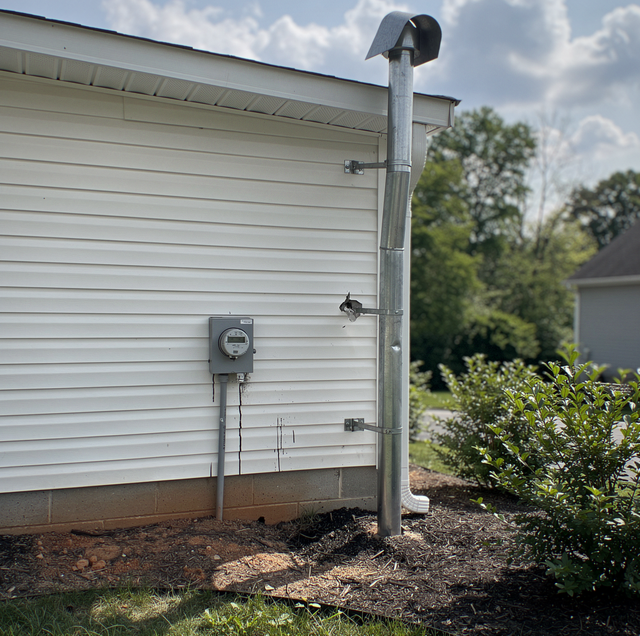
The equipment carrying power from the street into a house has two owners, and the boundary between them runs straight through the hardware bolted to the outside wall. Storm damage pays no attention to that boundary. Every repair that follows one does, and which side the damage is on decides who a homeowner calls first, who they call second, and what has to be finished before anyone gets the lights back.
Two houses on the same block can go dark in the same hour and face very different days. If wind and falling limbs brought down the utility's conductors up the street, restoration is a crew, a truck, and a place in line. If that same limb tore the service mast off the wall of one house, a utility crew can arrive, look, and leave it untouched, because the broken part belongs to the house. Working out which of those is true, from a safe distance, is the first useful thing a homeowner can do.
Quick Answer: The utility owns the drop from the pole and the meter itself. The homeowner owns the weatherhead, the mast, the meter base, and everything past the meter. That repair usually has to be finished, and often inspected, before the utility reconnects.
Where the Ownership Boundary Falls on Your Wall
For a house fed overhead, power passes through four named pieces of hardware before it reaches anything you switch on. Each has an owner, and the split is what makes storm damage confusing.
The service drop: These are the conductors that span the open air from the pole to the house, and they belong to the utility along their entire length, including the point where they land. A drop pulled down, stretched, or cut by a falling limb is utility work end to end.
The weatherhead: At the top of the mast, a hooded fitting is where the drop conductors turn down and enter the conduit. The hood and the downward loop of wire below it shed rain away from the opening so water runs off rather than following the conductors inside. The weatherhead belongs to the house.
The service mast: The mast is the rigid conduit running down the outside wall, carrying conductors from the weatherhead to the meter and holding the attachment point high enough to keep the drop clear of the ground. Its straps and anchors carry a real mechanical load because the drop hangs on them, and they belong to the house.
The meter base: The meter base, sometimes called the meter can or socket, is the enclosure bolted to the wall, and it belongs to the house along with its mounting. The meter plugged into it belongs to the utility, which is why it carries a seal and why a homeowner has no business removing it.
Past the meter, everything is the homeowner's: the service entrance conductors running to the main disconnect, the panel, and every circuit fed from it.
Where exactly a utility draws its boundary, and what gets permitted and inspected, varies by jurisdiction and by utility; your electrician and your utility confirm what applies at your address. The general shape holds nearly everywhere, and enough to make the first call the right one.
Reading the Damage from a Safe Distance
Everything below can be assessed from the ground or a window. None of it calls for a ladder, a close look, or a hand on anything.
Start with the mast, because a limb landing on the drop transfers its weight straight into it. The conduit bends away from the wall, straps tear out of the siding, or the whole assembly tilts, with the weatherhead pointing off at an angle. Sometimes the drop is the only thing holding the mast up, and the mast is the only thing holding the drop off the ground, a situation that can shift without warning. A meter base torn partly off the wall shows a gap behind the enclosure, siding pulled or split around it, the box hanging low or cocked to one side, or conductors visible where it separated.
A drop lying in the yard or draped across a fence is its own category, and the only one that changes what you do next. A conductor on the ground, in a tree, or lying on a car looks the same whether it is dead or live. It gets treated as live.
Water tracking into the meter is the quiet one. A bent or missing weatherhead hood, a cracked conduit joint, or a meter base pulled open at the top all provide a path for rain to enter the enclosure. Rust streaks under the box, staining on the siding below it, or fog inside the meter glass are signs that water got somewhere it does not belong.
Treat any downed or sagging conductor as energized, no matter how long the power has been out. Stay far back, keep children and pets away, call your electric utility, and call 911 if the line threatens people or traffic.
Who Repairs Which Side of the Boundary
Utility crews will not repair the customer-owned side, and the reason is worth understanding, because homeowners reasonably expect the crew in their yard to fix what is in front of them. That crew is dispatched, trained, and equipped to work the utility's system. The mast and meter base were installed under a permit issued for the house and, in most places, inspected before they were ever energized. The utility has no record of that assembly, no responsibility for its condition, and no standing to certify a repair to it. A crew that straightened a bent mast and re-energized the service would put the utility's name on work nobody qualified had checked.
The practical result: storm damage on the customer side keeps the service off until an electrician has repaired the equipment belonging to the house.
What Not to Do at the Service Entrance
The service entrance is the one part of a house's electrical system that remains energized when the main breaker is off, because the conductors upstream of the main are fed directly from the utility. That holds during an outage too, since power can return without notice.
- Do not approach, touch, lift, or move a downed conductor with anything, including a stick, a rope, or a tool with an insulated handle. Do not drive over one.
- Do not touch, straighten, brace, tape, tarp, or re-seat a damaged mast, weatherhead, or meter base. No ladder work at the service entrance, and nothing set against it for support.
- Do not pull the meter. Do not open the panel or remove a panel cover.
- Do not run or reset anything on equipment that is wet.
If the panel is dry, if you can reach it without standing in water, and if you can put a hand on the main breaker handle without touching a wet enclosure or wet metal, switching the main off while you wait is reasonable. If any of that is untrue, leave it alone and say so when you call.
If you run a portable generator while you wait, it is never plugged into a wall outlet and never wired into the house without a transfer switch or an interlock installed for the purpose, because power pushed backward onto the utility's lines can kill a line worker who has every reason to believe the circuit is dead. Appliances get plugged into the generator directly, on their own cords, outdoors and well away from the house.
A meter base or panel that has taken water does not go back into service on a homeowner's judgment. Water corrodes contacts and tracks across surfaces meant to insulate, so the equipment stays dead until an electrician has inspected it.
Why an Inspection Sits Between Repair and Reconnection
Replacing a mast, a meter base, or service-entrance conductors is usually permitted work, and a permit requires an inspection. In many jurisdictions, the utility will not restore power to a repaired service until the inspecting authority has released it. Whether that step applies to your repair, and what form it takes, varies by jurisdiction and by utility, and your electrician confirms it with both before work is scheduled.
The mechanism is the one keeping utility crews off customer equipment. The utility cannot verify work it did not perform, and reconnecting to a compromised service entrance means energizing a fault: a cracked enclosure with water in it, a mast whose grounding path broke when it tore loose, insulation damaged where conductors were dragged through a bend. The inspection is how the utility gets confirmation from someone who looked inside.
When the drop is the only casualty, none of this applies: the crew replaces it, and power comes back with no permit, no inspection, and no electrician involved.
Getting the Two Repairs in the Right Order
The sequence matters because each step gates the next, and skipping ahead usually costs a day rather than saving one.
Report the outage and keep everyone clear: This step runs whatever the damage turns out to be. If a conductor is down, the report is urgent, and the area around it stays empty.
Find out which side the damage sits on: From the ground, from a distance, without touching anything. A clear description of what the mast, meter base, and drop look like is often enough for an electrician to tell you over the phone whose repair it is.
Get the customer-side repair done: If the mast, weatherhead, meter base, or service entrance conductors are damaged, that work belongs to a licensed electrician and must be completed before anything else moves. The repair restores the mechanical and weather integrity the assembly is supposed to have.
Clear the inspection where it applies: This is the step homeowners most often do not see coming. A finished repair with no release behind it means a utility crew arrives at a service they still cannot energize.
Let the utility reconnect: The drop goes back up, the meter goes back in, and the service is live again.
Calling only the utility and waiting is the common mistake when the damage is on the house: it buys a place in a restoration queue for a repair that queue will never make. Calling only an electrician mirrors it when the damage is up the street. A few careful minutes working out which side broke, before either call, puts the rest of the day in order.
Frequently Asked Questions
Policies commonly treat customer-owned service equipment as part of the dwelling structure, so damage from a covered storm event is often claimable, though your policy and deductible decide that. Take clear photographs from the ground before any repair begins, because once the mast and meter base are replaced, there is nothing left for an adjuster to see. Your electrician's written, itemized scope is the other document adjusters ask for.
Then the trouble is almost certainly upstream, at a cutout fuse on the pole or in the shared equipment feeding your group of homes, and there is nothing on your side to repair. Report the outage and note whether the houses around you are also dark. A single dark house on a lit street points back at your own service equipment.
Yes, and the electrician normally arranges it. Drop conductors cannot be worked on live, so a scheduled disconnect and a later reconnect are requested as part of the job. Availability for that visit, more than the repair itself, frequently sets which day the work happens, which is why the request goes in early.
The ownership boundary still falls at the meter, but the hardware differs. The buried lateral feeding the house is usually utility-owned, so a tree lifting a root plate and dragging on those conductors is normally the utility's repair. The riser conduit coming up the wall, the meter base it elbows into, and the mast are not, and that is where a homeowner's cost sits.
Everything in the house re-energizes the instant the drop is reconnected, and the first moments after restoration are when the supply is least stable. Unplug sensitive electronics until things steady. While the service is open for repair is a sensible time to ask your electrician about a panel-mounted surge protective device.
A mast penetrating the roof deck sits inside a flashing boot with sealant around it, and that weatherproofing has to be cut out and rebuilt once the new mast is set and plumb. That adds work above the ceiling line to a job otherwise done on the wall. Enclosure availability adds time, too, since a meter base has to match the service and isn't something every truck carries.
Get your storm-damaged service entrance repaired — describe what you can see from a safe distance and get the mast, meter base, and inspection handled so the utility can reconnect. Rojas Electric serves Fairfax and all of Northern Virginia. Call (703) 810-3693.
