
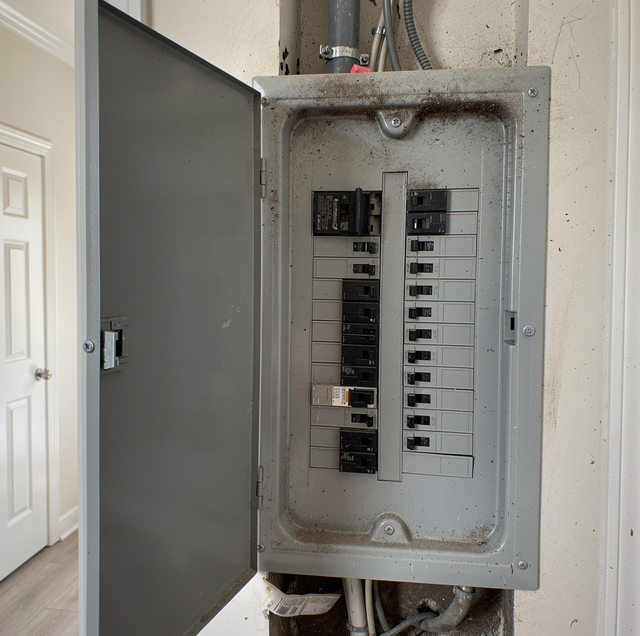
Your lights either flicker in one room or everywhere, and "everywhere" is the version with a short list behind it. When the kitchen and the back porch shiver at the same instant, they are sharing a fault, and the first part they all share is a single conductor: the service neutral.
There is a second fork inside that one, and you can settle it tonight. While the lights misbehave, does anything get brighter? A lamp flaring while another dims is a different event from a house that only dips, and it changes how fast somebody needs to be there.
Which Rooms Flicker, and Which Ones Hold Steady?
Sorting this works from the fixture outward toward the street, because each step out covers everything the step before it already covered, and the first step that explains all of your symptoms is the one to stop on.
Start at the smallest scale. One lamp flickers and nothing else does, and the same outward walk applies inside the fixture: the bulb first, then the socket's center contact behind it, then the lamp's own switch, then the wiring that feeds all three. Nothing about the rest of your house is implicated.
Widen to one room, or one run of outlets. Everything on that circuit dims together while the rest of your house holds steady, which puts the fault somewhere along that circuit, between its breaker and the last device on it. That is a small search, and none of it reaches your service.
Widen again to the whole house. If every room flickers only when a big motor starts and settles once it is running, that raises the question of whether the service and panel have enough capacity for the load you are putting on them. Separate diagnosis.
That leaves the version this article is about: every room, at once, on a rhythm matching nothing you switched on. Now the only parts left are the ones every circuit in the house has in common, and that is a short list. The service conductors, the meter enclosure, the main lugs, and the one neutral they all share.
What the Neutral Does on a 120/240-Volt Service
The transformer feeding your house has a secondary winding with a connection brought out at its electrical midpoint. The two ends of that winding are the two hot legs arriving at your panel. The midpoint connection is the neutral. A meter at the panel reads about 120 volts from either leg to the neutral, and about 240 volts from one leg to the other, with both readings taken against the same midpoint.
Every 120-volt circuit in your house connects one leg to the neutral. The lighting circuit in your bedroom may be on one leg, and the one in your kitchen on the other, because breakers alternate down the two bus stabs inside the panel, so roughly half the 120-volt circuits in the house are on each side.
That arrangement gives the neutral a second job beyond carrying current home. The two legs are 180 degrees out of phase, so the returning currents from the two sides cancel: with a 10-amp, 120-volt load on each leg, the neutral carries almost nothing. Whatever the load, it holds that midpoint fixed, so each leg has a steady 120 volts to work against. The conductor runs from the transformer, through the service conductors and the meter enclosure, to the neutral bar inside your panel, and every 120-volt circuit in the house depends on all of it.
The Fixtures That Brighten Are on the Lighter Leg
Open that midpoint connection, or let it corrode into a poor one, and the two sides of your house stop being independent. The 120-volt loads on one leg and those on the other are now strung end to end across the full 240 volts, with the point where they meet free to move. It settles toward whichever side draws more current. That side's circuits run below 120 volts and your lamps there dim. The other side's run above 120, and brighten.
That is why the pattern wanders. Each time a hair dryer or a space heater comes on, the balance shifts and the shared point travels with it, on a rhythm no single breaker or fixture can account for.
Fixtures brightening means one leg runs well above 120 volts, and metal bonded to the open neutral can sit at a voltage above earth: a shock risk as well as a fire risk. Call a licensed electrician rather than opening the panel.
The hazard runs two ways. That neutral is bonded to your home's grounding system at the service disconnect, so when it opens upstream, the metal that system reaches- appliance cases and the panel enclosure and metallic water piping- can sit at a voltage relative to the earth outside. And a joint gone loose short of fully open is a resistive connection carrying current, making heat inside an enclosure you cannot see into.
Equipment pays too. The voltage standard utilities follow, which sets the nominal 120/240 designation, puts service voltage for a 120-volt nominal system between 114 and 126 volts, the band a utility designs to at your service point. A leg well above that drives incandescent filaments hotter than they were built for, so lamps there look bright and fail early, and motor windings on that side heat with no fault any breaker would catch.
When Should You Stop Using the Affected Circuits?
The answer is behavioral, because nothing in your house is labeled by leg. The circuits to leave alone are the ones with devices acting strangely right now: a lamp burning visibly brighter than it used to, or a small appliance running hotter than it ever has. Those devices sit on the side running high, and they are the closest thing to a label you have.
The rest of the urgency comes from what the fault is made of. A neutral gone intermittent is a mechanical joint that has already lost contact area, and the current still crossing it crosses a smaller path each time. Nothing there improves while you wait for a convenient morning.
Taking a circuit out of use here means unplugging what sits on it, especially anything with a heating element or a motor. That protects the things you unplug. It does not correct the split, and it can leave whatever stays plugged in on that side sitting higher still. The fix is a service call.
There is also a timing issue, and it is more your responsibility than the electrician's. This fault exists only as a voltage difference while current is flowing, so a house that has settled by the time someone arrives offers nothing to measure. What you watched happen at nine last night does not come back on request, and it carries more weight than anything found on a quiet afternoon.
Before you call, write down whether anything got brighter while other lights dimmed. That observation sends a technician to a pair of leg-to-neutral readings, and the hour it happens gets the visit booked while the fault is still live.
The Uneven Split Across the Two Legs
A technician taking both leg-to-neutral readings at the main lugs in your panel while a large 120-volt load switches on and off gets a pair that move in opposite directions at the same moment. That is the reading the diagnosis turns on, and it is taken with the cover off a live panel.
Work the arithmetic and the numbers come out blunt. Say one leg carries twice the 120-volt load of the other. With the midpoint gone, the two sides sit in series across 240 volts and divide it in inverse proportion to their load: roughly 80 volts on the busier side, roughly 160 on the quieter one, and the two still adding to 240. Change what is running, and the pair walks to a new split. Neither figure is a limit or a rule; a meter reads it at that instant, on your house, with whatever you have going.
One category sits outside all of this. A straight 240-volt load, a resistance water heater or a well pump, connects across both legs and uses no neutral at all, so it takes its full 240 volts and runs normally throughout. A range or a dryer is the mixed case: the heating element sits across both legs, while the clock, the lamp, and the controls run at 120 volts from one leg to the neutral. Your own dryer, heating normally while its drum light dims, carries both halves of that inside one cabinet.
Frequently Asked Questions
Because your house is never at zero load. A refrigerator compressor, a freezer in the garage, a well pump, a sump pump, and a heat pump's crankcase heater all start and stop on their own thermostats and float switches, and each one changes how much current each leg carries. If the shared conductor is compromised, the split between the two legs shifts every time one of those cycles, with no one touching a switch anywhere.
No, and that is part of why it goes undiagnosed for so long. A breaker responds to current through its own hot conductor: too much for too long, or the sudden current of a short. A failed neutral produces neither. Both legs now carry the same current, a value landing between the two they carried before, so no breaker in your panel sees more than it already had, and every one stays closed.
It depends on what each device does with the voltage it gets. Pick up the adapter for your laptop or phone, and the label prints an input range, commonly 100 to 240 volts, because a switching supply regulates anything inside that band. A resistance heater, an incandescent lamp, or a motor has no such range. Power in a resistive element climbs with the square of voltage, so an element at 160 volts instead of 120 dissipates about 1.8 times its rated heat.
A main breaker interrupts the two hot legs and leaves the neutral running continuously through the panel, so throwing it does take the divided voltage off every branch circuit, and an electrician may do exactly that on arrival. It is still not a homeowner move here. With the neutral compromised, the panel enclosure and everything bonded to it can sit at a voltage relative to the ground under your feet, and the handle is mounted on that enclosure.
That circuit's own resistance. Copper's resistivity and 14-gauge wire's cross-section put a 14 AWG conductor near 2.5 ohms per 1,000 feet, so a 100-foot run measures about half an ohm out and back. Put a 12-amp load on that circuit and roughly six volts disappear in the wire before reaching the far end, enough for a lamp out there to dip while every other room in your house holds steady.
Because they convert voltage into light in different ways. An incandescent filament stores heat and takes tens of milliseconds to cool measurably, so a dip a few cycles long reaches your eye as a soft sag. An LED chip stores nothing and follows its drive current almost instantly, so what reaches you depends on the driver behind it: one design rides the dip out on stored charge, another passes it through. Same event, two verdicts.
Whole-house flicker with anything brightening on it is worth a reading taken while the condition is live — the pair of leg-to-neutral voltages under a switching load exists only while the fault is present, and no description over the phone and no photograph of a light fixture reproduces it. Rojas Electric serves Fairfax and all of Northern Virginia. Call (703) 810-3693.