
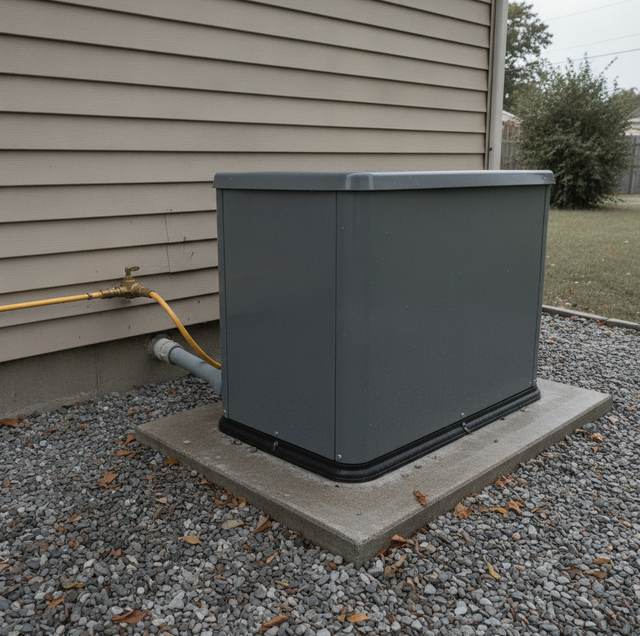
The power drops at two in the morning, and the house goes silent. With a battery backup, you might not even notice. A wall-mounted battery holds a charge from the day, and the instant the grid fails, its inverter picks up the load and keeps your circuits running on stored energy without a sound. A standby generator does the opposite. It sits outside like an air conditioner, waits for the outage, then cranks itself on within seconds and burns fuel to carry the house, running as long as the fuel keeps coming.
That difference in mechanism is the whole decision. A battery quietly discharges a fixed amount of stored energy, then remains empty until it recharges. A generator produces power on demand and can run for days, but it requires fuel, makes noise, and needs an engine to maintain. Neither is simply better. The right choice depends on how long you need to stay powered, what you need to keep running, and how often your lights actually go out. Here is how to line those up against each system instead of guessing.
What Each System Is Doing While the Grid Is Down
A home battery is rated two ways, and both matter. The first is capacity, measured in kilowatt-hours (kWh), which represents the total energy it can hold. A common residential battery stores around 10-13 kWh of usable energy. The second is continuous output, measured in kilowatts (kW), which is set by its inverter and caps how much you can pull at once. Capacity decides how long it lasts; the inverter decides how much it runs at once. Depth of discharge is the third number worth knowing, because the usable figure is often lower than the nameplate. Many lithium iron phosphate batteries are rated to discharge nearly all the way down, so their usable and nameplate numbers sit close together, while other chemistries hold a reserve you never get to use.
A standby generator is rated in kW, too, but it does not run out. An air-cooled residential unit produces a steady output while it runs, drawing on an external fuel supply rather than a stored charge. It starts automatically through a transfer switch, reaches speed, and holds your circuits up until the grid returns or the fuel stops. The tradeoff is that it is an engine, with oil, spark, exhaust, and moving parts, and it announces itself every time it runs. So the two systems recover differently: a battery gives you a quiet, finite bank of energy, while a generator gives you an ongoing supply that depends on fuel and needs the occasional maintenance visit.
Start With How Long, and What You Need to Run
The most useful question is not which system is fancier. It is how long your outages last and what has to stay on.
If your power tends to blink out for a few minutes or an hour or two at a time, a battery covers that comfortably and you never hear it. The grid takes hits from summer thunderstorms and winter ice storms alike, plus routine utility switching and the surge when power is restored, so short interruptions happen in every season, not just one. For those, a battery is often the cleaner fit, since most outages end before it runs low.
If your outages can stretch for a day or more, the math shifts. A battery holding a day's worth of essential circuits will carry a refrigerator, some lights, internet, and phone charging through a night. A generator does not care whether the outage lasts four hours or four days, as long as it is fed.
The loads decide a lot:
- A refrigerator or freezer is a light, steady load and the easiest thing to back up. A battery can run one for well over a day, and a generator does not blink at it.
- A well pump is the opposite. It is usually a 240-volt motor with a heavy starting surge, drawing several times its running current for a fraction of a second when it kicks on. That inrush can exceed a smaller battery inverter's momentary limit even though the running load is modest, which is why well-dependent homes often lean toward a generator or a battery with a high-output inverter.
- Medical equipment ranges widely. A CPAP sips power and can run all night off a modest battery, while an oxygen concentrator pulls a real continuous load and shortens a battery's runtime fast. If someone depends on equipment, the size of its actual draw.
- Whole-house air conditioning is the load that reshapes the whole decision. A central AC compressor has a large starting surge, and cooling the entire house is a sustained draw that a small battery cannot hold for long. Running full central air through a long outage usually points to a properly sized standby generator, or a larger battery paired with a soft-start device that tames the compressor's inrush.
Once you know your longest realistic outage and your must-run loads, the kW and kWh you need nearly name themselves.
Fuel, Refueling, and What "Runs for Days" Really Means
A generator's headline advantage is runtime, but runtime is a fuel story. A standby unit on a natural gas line has effectively continuous fuel, so it can run for days without anyone touching it. The same unit on propane is limited by the tank: a large buried tank lasts a long stretch, while a small one empties in a day or two under heavy load, and refills depend on a delivery you may not be able to schedule during a wide outage.
A portable generator is the simplest fuel-based backup, but it runs on gasoline you have to store safely and pour in by hand every several hours, including overnight, and it must sit well away from the house because of exhaust. It is a real backup, but a hands-on backup.
A battery has no fuel at all. It refuels by recharging from the grid once power returns or from rooftop solar during daylight. That last point is the battery's quiet advantage during a multi-day event: paired with solar, it can refill each day and carry essential loads each night, stretching a fixed bank of storage across an outage that would otherwise drain it once and stop. Without solar, a battery gives you one charge and then waits for the grid.
Noise, Space, Permitting, and Upkeep
Noise: A battery is silent. A standby generator runs at a steady drone whenever it is working, and it also exercises itself on a schedule, so it makes a brief noise even when the power is on.
Space: A battery mounts on a wall in a garage or outside and has no exhaust clearance. A standby generator needs a pad outside and clearances from windows, doors, and the property line so that exhaust vents can safely clear.
Permitting: Both systems are permitted and inspected work, not plug-in appliances. A generator on gas or propane also brings in the fuel side: the gas line has to be sized to feed the engine's demand, and a service or meter change is coordinated with the utility. That coordination and inspection shape the timeline, and it is the kind of thing a licensed electrician handles for you rather than something you file yourself.
Maintenance: A battery is close to hands-off, with no oil, no fuel, and no engine, though the cells degrade slowly over the years of cycling. A generator wants engine care: oil and filter changes after a break-in period and then on an hourly or annual interval, a starting battery, and a cool-down habit. Skip that upkeep, and the unit that is supposed to save the day may not start when the day comes.
The Transfer Switch, and Why Sizing Is the Whole Game
Whatever powers it, something has to connect it to your house safely, and that piece is the transfer switch. It keeps your backup source and the grid from ever being tied together at once, which protects your equipment and anyone working on the lines.
An automatic transfer switch is what makes a standby generator feel effortless. It constantly watches the incoming power, and when the grid drops, it signals the generator to start and switches your circuits over within seconds, then switches back and shuts the unit down when the grid returns, all with no one home. Home batteries do the same thing through their inverter and gateway, usually fast enough that sensitive electronics never reboot.
A manual transfer switch, often paired with a portable generator through an interlock kit, is the hands-on version. When the power fails, you roll the generator out, start it, and throw the switch yourself. It is simpler equipment, and it works, but only if someone is there to run it.
Sizing is where these projects go right or wrong. The transfer equipment and the backup source both have to be matched to the loads they carry. Under-size the generator or the battery inverter, and it stalls or trips when a big motor, like the AC or the well pump, kicks on. Oversize everything, and you have paid for capacity you never use. This is where a critical-loads subpanel earns its place: rather than backing up the entire house, an electrician moves the circuits you truly need during an outage, the fridge, the furnace blower, a few lights, the internet, and a medical device onto a dedicated subpanel that the battery or generator feeds. A smart panel takes this further, monitoring each circuit and shedding lower-priority loads automatically so the backup source is never overwhelmed.
A Quick Way to Point Yourself in the Right Direction
No table replaces a load calculation, but this is a fair first sort:
| If your priority is... | Lean toward... |
|---|---|
| Silent, automatic backup for short, frequent outages | Battery backup |
| Riding out outages that last a day or more | Standby generator |
| Running a whole-house AC or a well pump with a big surge | Standby generator, or a battery sized with a high-output inverter |
| No fuel to store, no engine to maintain | Battery backup |
| Backing only essential circuits without overbuilding | Either one, paired with a critical-loads subpanel |
| Recharging your backup from solar during a long outage | Battery backup |
| Simplest, hands-on backup with no engine to size around | Portable generator on a manual transfer switch |
Most homes land cleanly on one side once the outage length and must-run loads are on the table. Many people who can swing it layer the two: a battery for the quiet, instant coverage of frequent short blips, and a generator behind it for the rare multi-day event.
Matching the System to How Your Power Fails
The choice is really a match between how your power fails and what each system does best. Batteries win on silence, instant switchover, zero fuel, and near-zero upkeep, and they shine when your outages are short or when solar can refill them. Generators win on endurance, carrying a whole house through a long event as long as the fuel holds, and they handle the heavy surges of central air and well pumps that a small battery cannot. Get the sizing and the transfer switch right, decide whether you are backing the whole house or a critical-loads subpanel, and either system will do what you need when the grid quits. That is why the load calculation comes before the equipment.
Frequently Asked Questions
Sizing it comes down to one figure on the condenser's data plate: the locked-rotor amps, or LRA, the current the compressor pulls at the instant it starts. Compare that starting draw against the inverter's momentary surge rating, the short-duration peak it can pass above its continuous output, not the running wattage, since a compressor that runs on a handful of amps can spike to five or six times that on startup. A single-stage compressor slams to full speed and hits its full LRA every cycle, while a two-stage or inverter-driven variable-speed compressor ramps up and draws a much softer starting current a battery can absorb. If the LRA sits under the inverter's surge headroom, the unit will start; if it lands close, that is where a soft-start module or a larger inverter earns its place.
On a natural gas line, the fuel is effectively unlimited, so runtime is governed by maintenance rather than supply. Manufacturers generally recommend an oil and filter change after the initial break-in, then at set hourly or seasonal intervals. Air-cooled units are built for extended, but not truly endless, duty, while liquid-cooled models tolerate longer continuous runs. On propane, runtime is capped by tank size and how hard the unit is working.
A standby generator with an automatic transfer switch starts and carries the house on its own, and it self-tests on a schedule so it is ready. A battery does the same through its gateway, switching over fast enough that clocks and routers usually stay up. A portable generator does none of this: someone has to roll it out, start it, and flip the manual transfer switch, so it is poor protection for a house that sits empty during the day.
Yes, and the combination is common. A battery handles the frequent short outages silently, and the generator stands behind it for the rare multi-day event, even recharging the battery while it runs. They use separate transfer and control equipment, so the cleanest results come from planning the pairing up front, but a battery can also be added to an existing generator setup later, when the panel and space allow.
Yes, and the inspection checks more than the connection. On the electrical side, it verifies the transfer switch, the grounding and bonding, and the working clearances around the equipment. A fuel-burning generator adds a gas review, and the meter or regulator sometimes has to be upsized so the line can deliver the engine's peak demand rather than just the home's normal draw. A battery that can push power back also needs anti-islanding protection so it stops feeding the lines during an outage, which keeps utility crews safe. A licensed electrician handles the permit and these checks as one job.
It depends on how the source is sized against your service. A battery can back the whole panel, but only if you avoid running several big loads at once, the dryer, oven, water heater, and AC together, or the inverter hits its output limit and trips. That is why many whole-house setups add a load-management device that lets big appliances take turns, so a moderate battery or generator behaves like a much larger one. True whole-house coverage with no juggling means sizing the source to your full service, a larger install than most homes need.
Not sure whether a battery, a standby generator, or a critical-loads subpanel fits your house? Get a load calculation and a clear recommendation before you buy any equipment. Rojas Electric serves Fairfax and all of Northern Virginia. Call (703) 810-3693.
