
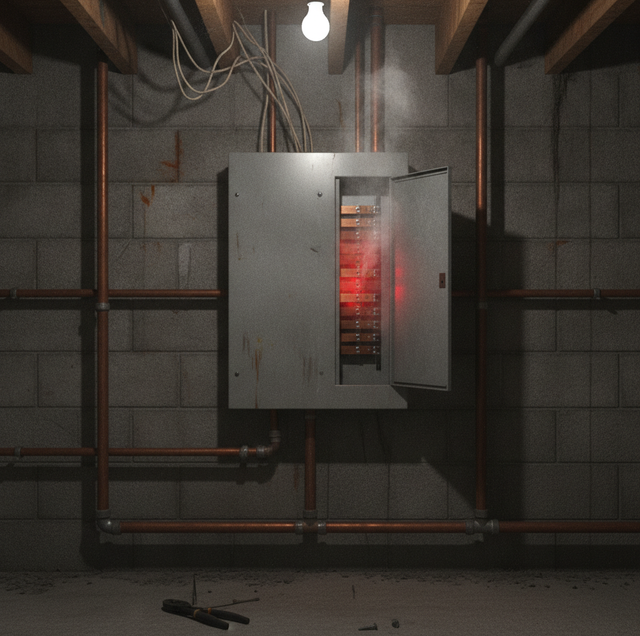
You are running the microwave and the coffee maker on a weekday morning, someone switches on a space heater down the hall, and the kitchen goes dark. You walk to the panel, flip the tripped breaker back on, and it holds until the next time those same things run together. Rest your palm flat on the metal cover, and it feels warm, warmer than the wall beside it. None of that is random. It is the panel telling you that the demand you keep asking of it has crept up to the edge of what it was built to carry.
An overloaded panel rarely announces itself with a single dramatic failure. It shows up as a pattern: the same breaker letting go under the same loads, lights that dip when the furnace blower kicks on, a faint buzz from behind the door. Reading those signs tells you whether you have a nuisance you can rearrange around or a panel that has run out of room.
What an Overloaded Panel Really Is
Two different things get called "overloaded," and separating them is the whole game.
The first is your service rating. The house is fed through one main breaker sized for a set amperage, most often 100, 150, or 200 amps. That number caps how much electricity the house can pull at any one instant. Inside the box, each branch breaker clips onto two vertical metal bars called busbars, which carry their own ratings. A panel is overloaded at this level when the total demand of everything running at once climbs toward that service or busbar limit.
The second is a single overloaded circuit. Each branch breaker, usually 15 or 20 amps, protects one run of wire feeding a set of outlets or a specific appliance. That breaker trips when the current on its wire passes what the wire can safely carry. A breaker is not protecting your toaster; it is protecting the copper in the wall from overheating. So, one circuit tripping when the hair dryer and the space heater share a bedroom is a circuit problem, not automatically a whole-panel problem.
Here is where people get crossed up. Adding more breakers does not add capacity. A panel can be physically out of open slots yet nowhere near its amperage limit, or it can be half empty on slots and already maxed on demand. Slots are about space. Amps are about the load. The two rarely run out at the same time, and only a load calculation tells you which wall you are actually hitting.
Reading the Signs at a Glance
Before the details, here is how the common symptoms line up with what is usually behind them and what to do next.
| Sign you notice | What it usually means | What to do |
|---|---|---|
| The same breaker trips when several things run together | That circuit, or the panel, is being pushed past its limit | Note what was running; have the load checked before adding more to it |
| The panel cover or a breaker feels warm to the touch | A connection or busbar is carrying heavy current, or a lug is loose | Stop stacking loads on it and get it inspected soon |
| The lights dim or flicker when a large appliance starts | Voltage is sagging under inrush on a strained service | Have the service capacity and connections evaluated |
| A buzz, sizzle, or hum comes from the panel | A breaker or connection is arcing or vibrating under load | Treat as urgent; keep the cover closed and call an electrician |
| A burning or hot-plastic smell near the box | Overheating at a terminal or breaker | Shut off the main if safe and call right away |
| Power strips and extension cords have multiplied | The home has fewer circuits than the way you now live | Ask about added circuits or a subpanel, not more strips |
When the Same Breaker Keeps Tripping
A breaker that trips once in a blue moon during an odd pileup is doing its job. A breaker that trips on a schedule, every time the same two or three things run, is telling you that the circuit lives too close to its limit in normal use. Resetting it over and over fixes nothing, and a breaker that trips repeatedly can weaken internally and eventually fail to trip when it should.
Whole-panel strain reads differently. When the total draw across the house nears the main breaker's rating, the main itself can trip, or several unrelated circuits act flaky at the times the house pulls hardest, a cold morning when the heat, the water heater, and the kitchen all run at once. Newer homes concentrate load in ways older services were never sized for: a heat pump, an electric range, two home offices, and a car charging in the garage can ask more of a 1980s 100-amp panel than it was ever built to give.
A Warm Cover, a Buzz, or a Smell
Electricity moving through a good connection makes a little heat, and a breaker working hard under a heavy load can feel mildly warm. What should worry you is a cover that is warm across a broad area, a single breaker that is noticeably hot, any discoloration around a breaker, or a smell of hot plastic. Those points to current squeezing through a connection that has loosened or corroded, and a loose lug builds heat that damages the breaker and the busbar around it.
Sound matters too. A healthy panel is silent. A steady buzz, a sizzle, or a crackle usually means a connection is arcing or a breaker is vibrating under load, and arcing is how heat becomes fire. If you hear it or smell it, that is not a wait-and-see situation. Keep the cover on, keep the load off what you can, and get it looked at quickly.
Older wiring raises the stakes here. Homes built in the 1960s and 1970s often ran aluminum branch-circuit wiring, which expands and contracts more than copper and tends to loosen at terminals over the decades. A warm panel in a house of that era deserves a close look at how those wires land.
Lights That Dim or Flicker Under Load
Watch what your lights do the instant a big motor starts, the air handler, a well pump, a shop vac. A brief dip as the motor pulls its inrush current is normal. A deep, lingering dimness or lights that flutter whenever large appliances cycle point to voltage sagging because the service is straining to deliver current, or because a connection in the path has gone high-resistance.
Flicker has more than one cause. A single flickering fixture is often just a loose bulb or a worn switch. Flicker that tracks with heavy loads across multiple rooms is the version that ties back to panel and service capacity, and the one worth mentioning to an electrician.
Power Strips, Extension Cords, and Too Few Circuits
Sometimes the clearest sign is not electrical at all; it is the workaround you have built to live with the shortage: power strips daisy-chained behind the entertainment center, an extension cord running a portable heater, a kitchen where the counter appliances fight over two outlets. That sprawl means the home has fewer circuits than you actually use today.
More strips do not add capacity; they concentrate more load onto a circuit that was already busy, which is how you end up back at the tripping breaker. The real fix is more circuits: dedicated lines for the heavy hitters like a microwave, a window unit, or a home office, so each demanding device has its own path back to the panel. That raises the question of whether the panel has room, electrically and physically, to give them.
What an Electrician Actually Does About It
The first move is not to sell you a bigger panel; it is a load calculation. An electrician tallies the home's square footage, fixed appliances, heating and cooling, and any large additions like a car charger, applies standard demand factors, and compares the total against your service rating. That number settles whether you are truly out of capacity or just out of well-arranged circuits.
From there, the fixes fall into a few buckets. If the service has headroom but you need more circuits, the answer can be as simple as adding branch circuits or installing a subpanel, a smaller box fed from the main that gives you more slots for a garage, a basement, or an addition. A subpanel adds room, not amperage, so it helps only when the main service still has capacity to spare.
If the calculation shows the main service itself is the ceiling, the fix is a service upgrade, typically moving a home from 100 amps to 200 amps, or to 400 amps for a large home with a car charger and electric heat. That is a bigger job because it touches the meter and the utility connection, so it requires utility coordination and a permit and inspection, which a full-service electrician handles for you. The upfront load calculation ensures you buy the right fix once, rather than adding a subpanel today and finding next year that the service was the real limit.
Putting the Signs Together
Any one of these can be minor on its own: a single flickering lamp, a breaker tripped during an odd pileup, a cover that is a touch warm on the hottest day. It is the pattern that matters. Repeat trips under the same loads, warmth, and sound at the box, lights that sag when the house works hard, and a growing pile of power strips add up to a panel that has outgrown your demand. A load calculation turns that hunch into a number: a few circuits, a subpanel, or a new service.
Frequently Asked Questions
Not always. A breaker under a heavy load can run mildly warm, and that alone is normal. The warning signs are heat you can feel across the whole cover, one breaker much hotter than its neighbors, browning or melted plastic, or a hot-plastic smell. An electrician can confirm it with an infrared thermometer or thermal camera by checking for a hot spot at a specific lug or breaker, which usually indicates a loose or corroded connection rather than the panel simply being busy.
Sometimes, but with limits. Tandem breakers (also called double or half-height breakers) fit two circuits in one slot, and they are only permitted where the panel's label lists the positions that accept them. Dropping non-listed "cheater" breakers into any open slot overloads the busbar there and is a real hazard. Even where tandems are allowed, they add circuits, not amperage. If the service is already near its limit, more breakers move you closer to trouble, not further from it.
Not in any meaningful way on its own. Your bill tracks the energy your appliances use, and rearranging that same load across more circuits does not change the total. The exception is a bad connection: a loose, high-resistance terminal wastes a little energy as heat, but the amount is tiny compared to the safety risk it represents. Treat a warm connection as a fire concern, not a billing one.
Through the load calculation, not a guess. The tally adds general lighting and receptacle load by square footage, each fixed appliance like a range or water heater, the larger of the heating or cooling load since those rarely run full-blast together, and any car charger, then applies demand factors that account for the fact that not everything runs at once. A home with gas heat may sit comfortably on 200 amps, while a large all-electric home with two car chargers can approach 400 amps. The math sets the number.
It depends on which limit you are hitting. If your main service still has spare capacity and you have simply run out of slots or need power in a detached garage or finished basement, a subpanel is often the cleaner, less invasive answer. If the load calculation shows the main service itself is maxed, a subpanel will not help, because it draws from that same overloaded main. A subpanel is not free capacity either: it runs off its own feeder breaker in the main, commonly sized at 60 to 100 amps, gets its own load check, and still lands on that same service and busbar ceiling, so it buys slots and convenience only when the main has headroom to spare. Only a service upgrade raises the ceiling, and that is the one that involves the meter, utility coordination, and an inspection.
It can contribute. Many homes wired in the 1960s and 1970s used aluminum for branch circuits, and aluminum expands and contracts more than copper as it heats and cools, which can loosen a terminal over the years and let it oxidize. A loose aluminum connection generates heat right where the wire meets the panel. The accepted repair is not simply retightening it, but adding listed copper pigtails at each connection using a rated method such as COPALUM or AlumiConn, so the breaker and device see copper. If your panel runs warm and the home is of that era, the terminations are worth having checked.
Notice the signs of an overloaded panel, and want a load calculation before you add another circuit or car charger? Rojas Electric serves Fairfax and all of Northern Virginia. Call (703) 810-3693.
