
Electrical Panel Warm or Hot to the Touch? What to Do
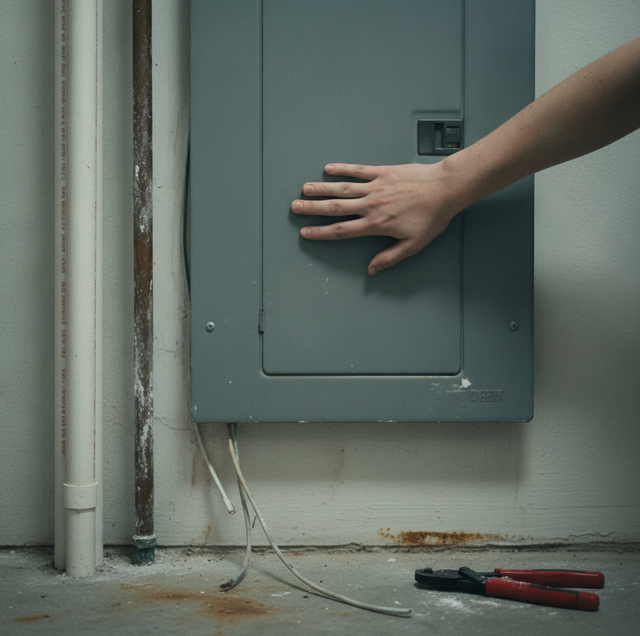
You reach past the laundry room door to reset a breaker, and the steel cover of the panel is warm under your palm. Not scalding, not enough to snatch your hand back, but clearly warmer than the drywall next to it. Sometimes it reaches you a different way: a faint smell of hot plastic near the panel, a buzz or a soft crackle you have not heard before, or a single breaker that feels warmer than the ones beside it. A panel that runs warm is telling you that somewhere inside, current is meeting resistance and turning into heat. What you do in the next few minutes is worth getting right.
What to Do When Your Electrical Panel Feels Warm
Work through these in order. The goal is to lower the heat, stay out of harm's way, and get the right person looking at it, not to diagnose it yourself with the cover off.
- Note which breakers and areas feel warm: Rest the back of your hand lightly against the cover and the individual breaker handles. Notice whether the whole panel is evenly warm or if one breaker or one corner is clearly hotter. Note which rooms or appliances those circuits feed. That single observation saves an electrician real time.
- Reduce the load on that part of the panel: Turn off or unplug the heavy hitters: a space heater, a window air conditioner, an EV charger, the oven, the clothes dryer, a portable heater on an extension cord. Less current through a warm connection means less heat right away, which buys time and lowers the risk while you make the call.
- Do not open the panel cover yourself: The flat metal door you see is the dead front, and it is the only thing standing between you and the energized bus bars, lugs, and wire terminals behind it. Removing it exposes live parts that carry the full service current. There is nothing a homeowner should be adjusting in there.
- Keep the panel clear and reachable: Move any boxes, coats, or shelving stacked in front of it or on top of it. An electrician needs room to work; trapped heat around a crowded panel only makes things worse, and a clear path matters if the circuit has to be shut off in a hurry.
- Call a licensed electrician and describe exactly what you noticed: Tell them where the heat is, whether you smell anything, whether you hear buzzing, and which circuits are involved. A good electrician can gauge how urgent it is from that description and often gives you a clear next step over the phone.
- If it is hot, smells like burning plastic, and buzzes or crackles, treat it as urgent: That combination points to an active fault, not just a busy circuit. If you can safely reach the main breaker at the top of the panel without touching anything else, switch it off to cut power to the whole panel, then call. If reaching it means putting your hand near anything that is hot, or if it makes you uneasy at all, leave it and call from a safe spot instead.
A warm panel is a real shock and fire hazard, not a quirk to live with. Never remove the panel cover, poke at a breaker, or touch the bus bars, lugs, or wires inside. Those parts stay energized even when individual breakers are switched off, and the current there can be fatal. If you see smoke, sparks, or any melted or scorched plastic, get everyone away from the panel and call 911 before calling anyone else.
What Causes a Warm or Hot Panel
Almost every hot panel comes down to one physical fact: electricity does not like poor connections, and where it encounters resistance, it dissipates energy as heat. A solid, tight connection carries current with almost no loss. A loose or corroded one acts like a tiny bottleneck, and the metal right at that point heats up, sometimes enough to discolor, soften, or char the plastic around it. A handful of specific problems create that resistance.
A loose lug or feeder connection: The largest wires in the panel, the service conductors, land on the main lugs under set screws torqued to a specific value. If a lug was never tightened to spec, or worked loose over the years as the metal expanded and contracted under load, the connection heats up under current. This is the single most common source of a hot panel, and it usually shows up right at the main.
An overloaded circuit: A breaker sized for a circuit will carry its rated current more or less indefinitely, but push a circuit near its limit for long stretches, with several big loads sharing one branch, and both the wire and the breaker run warm by design. A panel where many circuits are working hard at once, common when a home's demand has outgrown an older 100-amp service, tends to feel generally warm rather than hot in one spot.
A failing or loose breaker: A breaker clips onto a bus stab inside the panel. If that grip has weakened, or the breaker's internal contacts are worn, resistance builds at the connection, and the breaker itself gets hot. A breaker that trips more easily than it used to, or one noticeably hotter than its neighbors, is often on its way out.
Oxidized aluminum connections: Aluminum branch wiring, common in homes built in the late 1960s and 1970s, forms an insulating oxide layer and expands more than copper as it heats. At a terminal that was not treated and torqued correctly, that combination loosens the connection and generates heat, which is why listed copper pigtails, joined with the right connector and an antioxidant compound, are the standard remedy.
An undersized or aging service: A panel that was plenty for the home it was built for can be badly outmatched by today's loads: a heat pump, an EV charger, a couple of home offices, a kitchen full of modern appliances. Running near capacity for hours keeps the whole assembly warm and wears on every connection in it.
How an Electrician Finds the Heat
A good diagnosis does not rely on guessing which screw is loose. With the load running, an electrician can use an infrared thermal camera to see exactly which lug, breaker, or terminal is hottest, because the trouble spot glows brighter than everything around it. From there, the fix follows the fault: retorquing lugs to the manufacturer's specification with a calibrated driver, replacing a breaker that no longer seats tightly on the bus, pigtailing aluminum branch connections, or, when the service itself is the bottleneck or the bus bar is already heat-damaged, planning a panel or service upgrade. Work that changes the service also runs through the local permit and inspection process, which is there to confirm the repair is sound.
Frequently Asked Questions
Some warmth is normal when big loads are running. The main breaker and the service lugs carry the most current in the house, so a panel that feels slightly and evenly warm during heavy use, with laundry, cooking, and the air conditioning all going at once, is usually fine. What is not normal is a single breaker or one spot hotter than the rest, or a panel too hot to hold a finger against for more than a couple of seconds, which is roughly where plastic starts to be at risk. Even warmth across the cover is about load. A concentrated hot spot is about a connection.
It can, and the path is worth understanding. A loose connection does not just get warm; it can begin to arc, throwing a series of tiny sparks across the gap, which runs far hotter than simple resistance and can reach temperatures that ignite the breaker housing or the wire insulation. Because this happens inside a closed metal box, it can smolder and char for a long time before anyone notices a smell or sees discoloration. That slow, hidden progression is exactly why a persistent hot spot gets looked at promptly rather than watched.
It tracks with how hard the home is pulling power, and that runs high in more than one season. Summer air conditioning and a heat pump on a hot afternoon draw heavily, and so do electric space heaters, well pumps, and a furnace blower on a cold night. A panel mounted in an unconditioned garage also starts from a warmer or colder ambient baseline, so the same load feels different in July than in January. Heavy demand at either end of the year raises current through every connection, so a marginal one tends to reveal itself when the house is working hardest.
You do not have to shut the whole house down. Lighting and small electronics draw little through the panel and are fine to leave running; the loads worth cutting are the 240-volt heavy hitters, the clothes dryer, the EV charger, and central AC or a heat pump, since those push the most current through the connections that are heating up. If only one circuit feels warm, you can switch off that single breaker at its handle and leave the rest of the house on, rather than derating everything. The exception is the urgent case: if the panel is hot and you smell burning plastic or hear buzzing, stop using it and have it looked at right away, because that points to an active fault rather than a busy circuit.
This is riskier than it looks, for two reasons beyond the shock hazard of an open panel. First, the heat is often not in the breaker at all, but at the bus stab it clips onto, so swapping the breaker leaves the real problem in place. Second, a breaker that has run hot can damage the bus clip it sits on, which is why a proper repair checks the bus itself, not just the part that is easy to pop out. Panels also accept only specific listed breakers, and the wrong one can seat loosely and make the heat worse.
Not always. Plenty of hot panels are solved by retorquing a single loose lug or replacing one worn breaker. A full replacement enters the picture when the bus bar itself has been heat-damaged, when the service is simply too small for the home's load, or when the panel is one of the older hazard-brand boxes, such as Federal Pacific or Zinsco, whose breakers have a known history of failing to trip. In those cases, the heat is a symptom of a panel that has reached the end of its service life.
If your electrical panel feels warm or you smell hot plastic near it, have a licensed electrician find the source before it worsens, because a warm panel is usually a fixable connection problem when it is caught early. Rojas Electric serves Fairfax and all of Northern Virginia. Call (703) 810-3693.
