
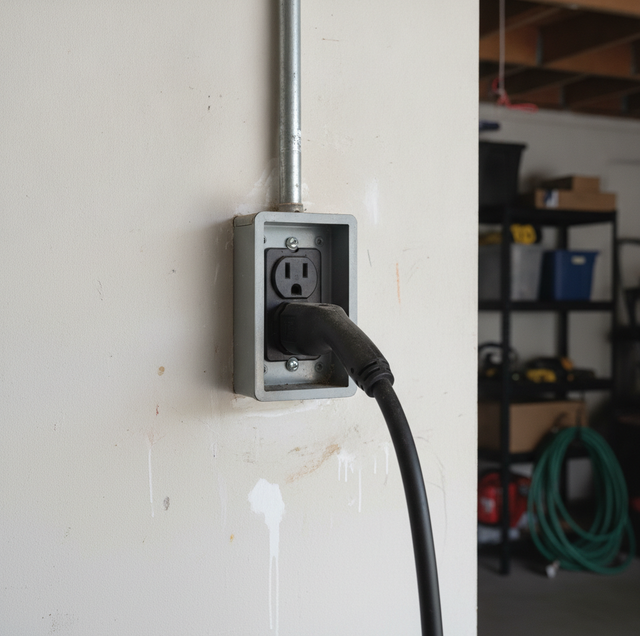
Most new EV owners walk in assuming they need the fastest charger they can buy. It feels like the safe bet: more speed, less waiting, one less thing to think about. But the right charger at home isn't the fastest on the shelf. It is the one that quietly keeps up with how you actually drive. The real question is not "how fast can it charge," it is "how many miles can it put back while the car sits in your driveway overnight." Once you answer that, the choice between Level 1 and Level 2 usually makes itself. Some drivers are fine with the cord that came in the trunk. Others are chasing their own range every morning and do not realize that a dedicated circuit would end the problem for good.
Level 1 and Level 2 in Plain Terms
Level 1 is the charging you already own. It is the portable cord that ships with almost every EV, and it plugs into an ordinary 120-volt household outlet, the same kind that runs a lamp or a phone charger. No electrician, no new wiring, nothing to install. You plug in, and it trickles power into the battery.
Level 2 steps up to 240 volts, the same class of circuit a clothes dryer or an electric range uses. It needs its own dedicated circuit run from your electrical panel, either feeding a NEMA 14-50 receptacle that a plug-in charger connects to, or wired directly to a hardwired wall unit. That is where an electrician comes in. Both levels deliver alternating current to the car, and the car's onboard charger converts it to the direct current the battery stores. The difference is not the type of electricity. It is how much of it flows per hour.
Level 1 vs Level 2 at a Glance
| Level 1 | Level 2 | |
|---|---|---|
| Voltage | 120V standard outlet | 240V dedicated circuit |
| Range added per hour | About 3 to 5 miles | About 20 to 35 miles |
| Power delivered | Roughly 1.2 to 1.4 kW | Roughly 7.7 to 11.5 kW |
| Circuit needed | Existing 15A or 20A outlet | Dedicated 40A to 60A 240V circuit |
| Install work | None; use the cord that came with the car | New circuit and breaker, NEMA 14-50 receptacle or a hardwired unit, plus a permit and inspection |
| Best for | Short daily commutes, plug-in hybrids, and cars that sit for long stretches | Longer commutes, larger-battery EVs, two-EV homes, short overnight windows |
The numbers above are ranges on purpose. Where your car lands within them depends on the circuit's amperage and the vehicle's efficiency, both of which the next section breaks down.
Why 240 Volts Adds Five to Nine Times the Range
The speed gap between the two levels is not magic; it is arithmetic. Power is volts multiplied by amps, and it is measured in watts (a thousand watts is one kilowatt, or kW). A Level 1 cord on a standard outlet pulls around 12 amps at 120 volts, which works out to roughly 1.4 kW. A common Level 2 setup delivers 40 amps at 240 volts, or about 9.6 kW. Doubling the voltage and more than tripling the amperage stacks up fast, and that is how Level 2 ends up moving five to nine times the energy per hour.
Range is the part you feel. Most EVs travel between three and four miles per kilowatt-hour of energy. Multiply that by the power flowing in, and Level 1's 1.4 kW turns into roughly 3 to 5 miles of range per hour. A 9.6 kW Level 2 circuit turns into something closer to 30 miles per hour, and a higher-amperage 48-amp circuit at about 11.5 kW pushes past that. A full overnight on Level 1 might recover 40-60 miles. The same window on Level 2 can refill an almost-empty battery.
One rule shapes what a given circuit can actually deliver, and it surprises people. EV charging is treated as a continuous load, meaning it runs for three hours or more without a break. A circuit carrying a continuous load can be worked only to 80 percent of its breaker rating. So a 50-amp breaker feeding a NEMA 14-50 outlet tops out at 40 amps of charging, which is why a "50-amp" plug so often caps near 9.6 kW rather than the full 50. Step up to a 60-amp circuit, and the ceiling rises to 48 amps and about 11.5 kW. This is also why the charger, outlet, wire, and breaker all have to be sized together. The weakest link sets the real limit, not the sticker on the box.
Which One Fits the Way You Drive
Forget the spec sheet for a moment and look at two numbers from your own life: how many miles you drive on a normal day, and how many hours the car sits parked and plugged in at home. Those two figures decide this more than the charger does.
Say your car sits for 12 hours overnight. On Level 1 at roughly 4 miles per hour, that is close to 50 miles put back before morning. If your daily driving lives under that, and most commutes do, Level 1 can keep your battery flat over a week without you ever thinking about it. Plug in at night, unplug in the morning, repeat. This is the case that the fastest-charger instinct tends to miss. A short commuter whose car sleeps in the garage may never need anything more.
The math turns the other way when either number moves. Drive 60 or 80 miles a day and Level 1 falls behind: you add 50 miles overnight but spend more than that, so the battery drifts lower each morning until you are hunting for a public charger. Shrink the parked window too, say the car is only home from 9 p.m. to 5 a.m., and even moderate daily mileage outruns a trickle. Two EVs sharing one driveway multiply the demand and almost always tip the answer toward Level 2. And larger battery packs, the ones that give long range, simply take longer to fill, so a slow feed leaves them perpetually short of full. If any of that sounds like your week, a 240-volt circuit can stop the daily range anxiety rather than just managing it.
What a Level 2 Install Actually Involves
Adding Level 2 is real electrical work, not a gadget you hang on the wall. An electrician runs a dedicated 240-volt circuit from your panel to the parking spot, using wire sized to the amperage the charger will draw, on a matched breaker. From there, it is either a NEMA 14-50 receptacle for a plug-in unit or a direct hardwired connection, and each has trade-offs covered in the questions below.
The step people skip is the panel itself. Before any wire gets pulled, the existing service needs a load calculation to confirm it can carry another large continuous circuit on top of the heat pump, water heater, oven, and everything else already drawing power. Older homes running an undersized 100-amp panel are frequently near their limit before an EV enters the picture, and the honest fix ranges from a smart load-management device that pauses charging when other big loads switch on, to a subpanel, to a full service upgrade coordinated with the utility. A permit and an inspection are part of a proper job, too, which protects the wiring behind your wall and your homeowner's coverage if anything ever goes wrong. This is also why the same charger costs very different amounts of labor to install in two different houses: the charger is standard, the panel and the wire run are not.
Where Cold, Heat, and Long Trips Fit In
Range is not a fixed number, and the gap between Level 1 and Level 2 matters most on the days your car is hungriest. Cold weather is one of those days. A cold battery accepts a charge more slowly, and cabin heat draws extra energy on the road, so winter can noticeably trim real-world range and thin out the margin Level 1 leaves you with. But heat does the same job from the other side: running air conditioning hard, sustained highway speed, and towing all cut range in warmer months. The takeaway is not to plan around one season. It is to size your charging for your heaviest-use stretches, not the mild days, so a rough week never leaves you short. If Level 1 only just keeps up in spring, it will likely fall behind in both January and July.
What the Choice Comes Down To
The fastest charger is not automatically the right one, and the cheapest option is not automatically enough. It comes down to whether your car can recover the miles you spend in the hours it sits still. Short daily drives plus a long overnight equals a strong case for staying on Level 1. Longer commutes, a second EV, a big battery, or a narrow parking window all point to a dedicated 240-volt circuit. Before buying any hardware, it is worth getting a load calculation on your panel, because that tells you both what your home can support and what charger amperage you can actually use. Match the charger to your week and your panel, and you buy once instead of twice.
Frequently Asked Questions
Sometimes, but with caveats. A dryer typically sits on a 30-amp NEMA 14-30 outlet, not the 50-amp NEMA 14-50 many chargers expect, so you would be limited to about 24 amps of charging (the 80 percent continuous-load ceiling on a 30-amp circuit), roughly 5.8 kW. You also cannot run the dryer and the car at the same time on a shared circuit, and splitting a single circuit between two appliances is not safe to improvise. Some portable chargers ship with swappable plug adapters to match a 14-30, which is handy for renters, but a dedicated circuit is the cleaner answer for daily use.
For everyday home charging, the level makes little difference to battery health. Both Level 1 and Level 2 feed alternating current that the car's onboard charger converts before it ever reaches the cells, and 240-volt home charging is still gentle compared with the DC fast charging you find on the road, which is what actually stresses a pack with heat. The habit that helps a battery most is setting a daily charge limit around 80 percent for routine driving and saving 100 percent for trip days. That setting matters far more than whether you got there at 4 miles per hour or 30.
Both work well; the deciding factors are amperage and location. Plug-in units on a NEMA 14-50 are easy to swap or take with you, but the receptacle itself must be protected by a GFCI breaker, and plug-in designs generally cap around 40 amps. If you want a 48-amp unit at about 11.5 kW, that has to be hardwired, since a standard 50-amp receptacle cannot carry it continuously. Hardwiring is also the sturdier choice outdoors and in humid spots like a detached garage, where a plug connection experiences greater temperature swings and moisture over the years.
That is common, and the modern answer is load management rather than a bigger service. An EV energy-management system (EVEMS) sits between the panel and the charger and monitors the home's total draw in real time, pausing or throttling the car the moment the dryer, oven, or AC pushes the house toward its limit, then returning the full rate when those loads drop off. A load-shedding smart panel does the same job at the busbar, prioritizing circuits so the EV yields to whatever else switches on. Either one lets a 100-amp service carry a Level 2 circuit it could not support if both ran flat out, which sidesteps the cost and utility coordination of a full upgrade. The charger still needs its own properly protected circuit, but the capacity question is addressed by scheduling the load rather than enlarging the panel.
Yes, and it is a smart way to avoid running two separate circuits. Load-sharing chargers, or two units linked on a single circuit, split the available amperage among whichever cars are plugged in and return the full rate when only one is charging. Two cars pulling from one 48-amp circuit charge at roughly half speed when both are connected, which is usually still plenty overnight. The alternative, two independent circuits, delivers full speed to each but demands far more panel capacity, so the sharing approach is often the practical pick for a two-EV household on an older service.
Usually not. A plug-in hybrid carries a small battery, often good for 20 to 40 electric miles, and a Level 1 cord can typically refill it overnight with hours to spare. On top of that, many plug-in hybrids have a modest onboard charger, sometimes limited to around 3.3 kW, so they physically cannot use most of a Level 2 unit's output even if you install one. Level 2 earns its keep for full battery EVs and for households that want every plug-in vehicle topped off fast; for a lone plug-in hybrid with a garage outlet, the cord in the trunk is often all it needs.
Ready for faster home charging — get a load calculation and a clear Level 2 install plan before you buy the hardware. Rojas Electric serves Fairfax and all of Northern Virginia. Call (703) 810-3693.
