
There is a power strip behind your TV with a little green light, and probably another one in a drawer you swear still works. So the surge question feels handled. It is not. That strip protects whatever is plugged into its own outlets and nothing else, which leaves out almost everything expensive in the house. The furnace or heat pump control board is hardwired. So is the well pump, the range, the wall oven, the dishwasher, and every recessed LED driver in the ceiling. None of that runs through a strip. The belief that a few cords in the living room cover the whole home is the most common misreading of how surge protection works, and it's worth clearing up before deciding whether the whole-home version earns its place.
The gap matters because the priciest things to replace are exactly what a power strip never touches. A modern home is full of circuit boards that used to be simple mechanical parts, and they sit on circuits that terminate at the panel, not at an outlet strip.
What a Power Strip Actually Covers
A plug-in surge strip is what the trade calls a Type 3, or point-of-use, device. It sits at the end of a branch circuit and clamps voltage for the few things plugged into it, which is useful for a computer or a television and not nothing. But it has three built-in limits. It only guards its own outlets. It has a low energy rating, so a large spike can overwhelm it in a single event. And when its internal parts wear out, the outlets often keep passing power with no protection left, so the green light stays on while the guard is gone.
That makes a strip the last layer, not the whole system. The heavy lifting has to happen where every circuit in the house passes through a single point: the panel.
Where the Voltage Spikes Actually Start
Most people picture a surge as a lightning bolt hitting the house. That happens, but it is a rare case, not the one that quietly kills electronics over the years. Surges come from two directions, and the everyday one starts inside your own walls.
The outside source is the grid. A distant lightning strike does not need to hit your roof to matter; a strike a mile away can induce a voltage spike that rides the utility lines into the neighborhood. Summer thunderstorms bring these, and so do winter ice storms that drop limbs on lines and force the utility to switch and reroute power. When the utility clears a fault or restores power after an outage, the reconnect itself can send a jolt down the line. So the outside threat is not a single season. It arrives with summer storms and winter ice alike, plus routine grid switching unrelated to weather.
The inside source is the one almost no one thinks about, and it runs all year. Every motor in the house generates a small voltage spike when it switches off. The compressor in an air conditioner or heat pump, the well pump, the refrigerator, the washer, the pool pump, each collapses a magnetic field when it stops, dumping that energy back onto the wiring as a transient. These are small next to a lightning-induced surge, but they happen dozens of times a day. Industry and utility estimates often attribute the majority of surge events, a figure sometimes cited as sixty to eighty percent, to these internal sources rather than the grid. Whether that exact split holds in a given home or not, the wear is constant, and it comes from ordinary appliances cycling, not from the sky.
That is why surge protection is not a storm-season purchase. The grid feeds it in every season, and the motors in the house feed it on clear days too.
What a Panel-Mounted SPD Does When a Spike Arrives
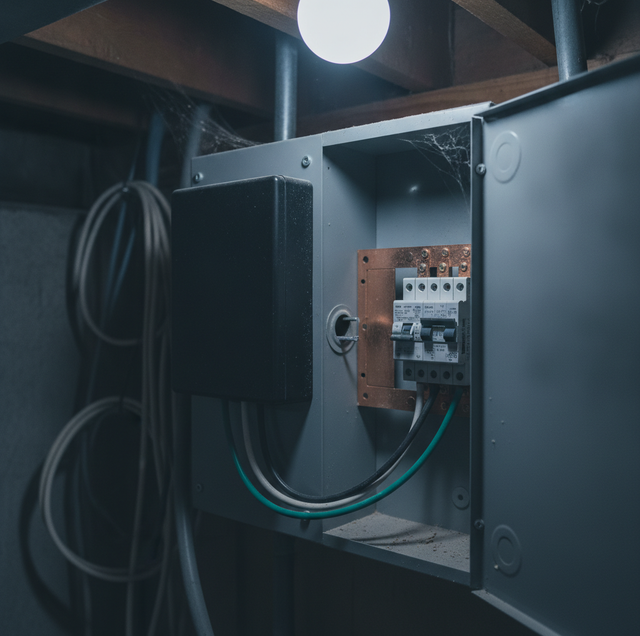
A whole-home surge protective device, or SPD, mounts at the electrical panel and watches every circuit that leaves it. The residential workhorse is a Type 2 SPD installed on the load side of the main breaker, usually occupying two breaker positions or bolted to the side of the panel. Some setups add a Type 1 device on the line side, ahead of the main, where the service enters. Type 1 and Type 2 perform the same core job; the difference is in the service in which they are rated.
Inside the device are metal-oxide varistors (MOVs). At normal voltage, an MOV is nearly an open door and does nothing. The instant voltage climbs past its threshold, its resistance collapses, and it becomes a low-resistance path to ground, shunting the excess energy away from your circuits in a matter of nanoseconds. Then it resets and waits. That is the whole trick: it diverts the spike to the ground path before it reaches the furnace board or the dimmer.
Two specs tell you how a given SPD performs. The first is surge current capacity, measured in kiloamps, often in the range of forty to eighty kA per mode on a good residential unit; that is how big a hit it can absorb. The second, and the one that protects your gear, is the let-through voltage, or VPR (voltage protection rating): what the device lets pass while clamping, commonly 600 to 1,000 volts on a 120-volt system. Lower is better, because your electronics see whatever gets through. A device that clamps to 700 volts for a few microseconds is doing its job; the boards downstream are built to shrug off a brief pass at that level, not a raw 3,000-volt transient.
Two installation details decide whether the rated numbers mean anything in your house. The device is only as good as its ground path, so it needs a solid grounding electrode connection to have somewhere to send the energy. And the leads connecting it to the bus must be short and straight, ideally under a foot with no sharp loops. Every extra inch of lead and every tight bend adds inductance, and that inductance raises the voltage the equipment actually sees during the strike. A panel SPD wired with long, coiled leads can measurably underperform its own label, which is a large part of why the job belongs to someone who wires it tight and grounds it properly.
Why Serious Protection Comes in Layers
A panel SPD is the first and biggest catch, but not the finish. It clamps the large transient yet lets a residual through, and it sits a full run of wire from the sensitive device in the back bedroom. That residual, plus spikes the motors themselves make downstream of the panel, is what point-of-use protection is for. This is why the trade talks about layered, or cascaded, protection: the panel device takes the brunt, and a unit at the computer or media rack tightens the clamp right at the electronics.
The two layers are meant to work together, not compete. Point-of-use units are designed to sit a good length of wire, often cited as at least about thirty feet, from the panel device, so the larger unit absorbs the surge first and the smaller one handles what is left. Set right next to the panel, the two can fight over the same energy; spaced as intended, each does its part.
| Attribute | Panel-mounted SPD (Type 2) | Plug-in power strip (Type 3) |
|---|---|---|
| What it protects | Every circuit in the house, including hardwired HVAC, well pump, range, and LED drivers | Only the devices plugged into its outlets |
| Surge capacity | High, often 40 to 80 kA per mode | Low, rated in joules, meant for residual energy |
| Handles the large transient | Yes, it is the first line | No, it can be overwhelmed by a big hit |
| Clamping at the device | Coarser, sits a run of wire from your electronics | Tighter, right at the sensitive gear |
| When it wears out | Status indicator light; module or unit is swapped | Often keeps passing power with no protection left |
| Data and coax lines | Not covered by a power SPD alone | Some strips add phone, coax, or Ethernet jacks |
Read the table as a decision, not a sales sheet. Neither column wins outright. The panel device covers what a strip cannot reach and takes the hit a strip cannot survive; the strip adds a tight final clamp and, on some models, protection for the coax or Ethernet line that a power SPD does not watch. Together, they cover the house; alone, each has a hole.
Deciding by What Your Home Actually Runs
Whether it is worth it comes down to an honest inventory of what is hardwired and electronic in your house, not a blanket yes or no. The more of the following you own, the more one-panel events stand to cost, and the more the math favors protecting the whole service over a few outlets.
Walk the house and count. A heat pump or air conditioner with a variable-speed compressor and control board. A furnace with electronic ignition. A well pump, if you are on a well, since replacing one means pulling it from the ground. A modern range or wall oven with a logic board. Recessed LED lighting throughout, each fixture holding a driver that fails from voltage stress. A smart panel, a battery system, or an EV charger, all carrying electronics, a surge can reach. A home full of these is one where a single grid transient can take out several boards at once, and where the constant internal surges quietly shorten the life of everything with a chip in it.
The opposite case is real too. A small home with older mechanical appliances, basic lighting, and little in the way of electronics has less at stake from any one event. The device still adds a margin of safety, but the urgency is lower. The decision is a read of exposure, not a moral one. Older homes carry a second wrinkle: a panel already full or undersized may not have two free positions for a Type 2 device, in which case the fix is an external-mount SPD beside the panel or a look at panel capacity first. That is a reason to have the panel checked, not a reason to skip the protection.
Reading Your Own Exposure
Whole-home surge protection is worth it in proportion to how much of your house has quietly gone electronic, and for most homes built or updated in the last couple of decades, that is most of it. The panel device covers the hardwired equipment that a power strip was never able to reach, and it earns its keep against the steady internal surges as much as the occasional storm. Pair it with point-of-use units at the electronics that matter, install it with a tight ground and short leads, and you have covered the house the way physics requires. The power strip was never the wrong idea. It was just the last inch of a job that starts at the panel.
Frequently Asked Questions
No, and no honest device claims to. A direct strike carries hundreds of thousands of amps and voltage in the millions, energy far beyond what any panel SPD is built to absorb; it will sacrifice itself and still likely let damage through. What an SPD is built for is the far more common induced surge, the spike that rides in from a strike a mile away or from grid switching. Guarding against a direct hit is a separate system: air terminals (lightning rods) and heavy down-conductors bonded to ground, a specialized installation most homes do not have or need.
The MOVs inside degrade a little with each surge they absorb, and a sufficiently large single event can retire a device in one shot. A quality panel SPD carries a status indicator, usually a green light that turns red or goes dark, and better units add an audible alarm, because the failure is otherwise silent. A worn device keeps passing power normally with no protection behind it, the trap with cheap strips that have no indicator at all. After any major surge or nearby strike, check the indicator; a spent panel module is typically swapped without replacing the whole unit.
Usually yes. A Type 2 device connects through a double-pole breaker and needs two open positions, or it bolts to the side of the panel and lands on the bus with short leads. The catch shows up on older or fully loaded panels with no free slots, common in homes still running an original 100-amp panel packed with tandem breakers. In that case, a full panel is still not a dealbreaker. A Type 1 SPD is rated to mount on the line side, at or just after the meter, before power reaches the breakers, so it claims no slot in the panel at all. Failing that, an external-mount SPD in its own small enclosure wires into the system through a short feed beside the box, keeping the leads tight without freeing up a position. Either route protects a packed panel, though a box already at its capacity limit is worth a look on its own.
For sensitive and data-connected electronics, yes. The panel device stops the large transient but lets a residual through and sits a full circuit run from the device in the back room, so a point-of-use unit tightens the clamp at the equipment. There is a second reason that catches people off guard: surges also travel in on coax and Ethernet lines, not just the power wire, and a power-only panel SPD does not watch those paths. A point-of-use unit with coax or network jacks closes that gap for a TV, modem, or game console.
There is no fixed number, because lifespan depends on how many surges it eats and how large they are, not on a calendar. The MOVs have a finite cumulative energy budget, and a home on a rough grid or with heavy motor cycling spends that budget faster than a quiet one. Manufacturers publish warranties, sometimes long ones, but treat those as a product claim, not a guarantee that your device is still protected, which is why the status indicator matters more than the years.
No, and this is a common mix-up. An SPD clamps brief overvoltage transients measured in microseconds; it does nothing for a sustained sag, brownout, or steady overvoltage. A more damaging cousin is a lost or open neutral, which can push sustained high voltage onto half your circuits and cook appliances in a way no surge device addresses. Persistent flickering, or lights that brighten when large loads switch, points to a wiring or service issue that needs diagnosis, not a surge protector.
Have your panel and what it feeds checked before the next storm or the next pump cycle decides, and a master electrician can tell you whether whole-home surge protection fits your home over the phone. Rojas Electric serves Fairfax and all of Northern Virginia. Call (703) 810-3693.
