Getting an EV in Fairfax? What to Know Before the Charger Goes In
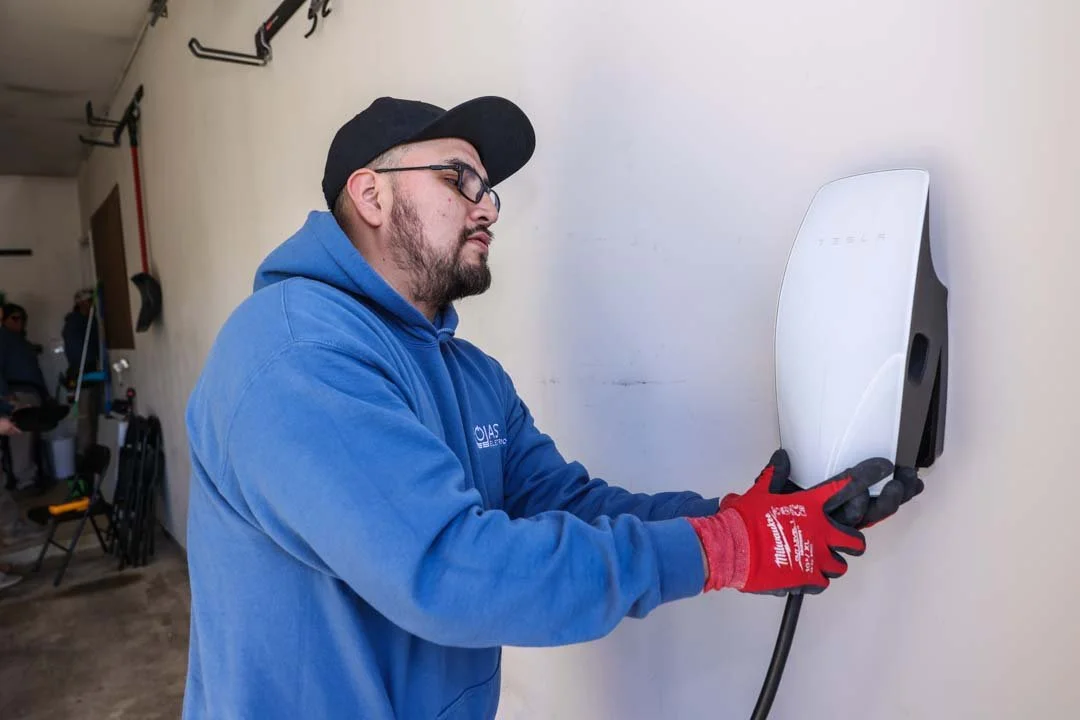
You ordered the car, or you are close to it, and now you are thinking about the charger. The dealer mentioned a home charger. Maybe your car manufacturer sent you a link to an installer. It seems like a straightforward addition — you have a garage, you have power, you plug in a charger. What most Fairfax, VA, homeowners do not realize until an electrician actually looks at the situation is that the car is the easy part. The panel, the wiring path, the available circuit capacity, and the condition of the garage electrical setup are what determine whether the charger goes in cleanly or whether you are looking at a bigger project than you expected.
The disappointment usually comes when an EV charger installer shows up, looks at the panel, and tells you there is no room for the 50-amp breaker the charger needs, or that the garage is too far from the panel for the wire run to be practical without significant work, or that the 100-amp service the house is running on cannot absorb a 40-amp continuous EV load on top of everything else the home already draws. None of these are rare situations in Fairfax, VA, where a significant portion of the housing stock predates the EV era by decades. Getting a preliminary electrical evaluation done before the car arrives, rather than after, is how you avoid turning the car delivery day into the day you find out the installation is going to take longer than you planned.
The Panel Check That Has to Happen First
An EV charger on a dedicated circuit requires a breaker sized at 125 percent of the charger's continuous current draw. A 32-amp Level 2 charger needs a 40-amp dedicated breaker. A 48-amp charger needs a 60-amp dedicated breaker. Before any of that is possible, the panel needs to have an available slot for a new double-pole breaker of the correct amperage, and the service needs enough remaining capacity to absorb the continuous load the charger will draw. For Fairfax, VA, homes with 200-amp service panels that are reasonably loaded, adding an EV charger circuit is usually feasible without a service upgrade. For homes with 100-amp service or 150-amp service panels that are already running close to their rated capacity, the EV charger load can push the total demand past what the service was designed to handle, and a service upgrade becomes part of the conversation.
The load calculation that determines whether the panel can absorb the EV charger involves adding the charger's continuous draw to the home's existing calculated load and comparing the result against the service rating. Under the NEC load calculation methodology, the existing loads in the home are subject to demand factors that recognize not everything runs simultaneously at full capacity. The EV charger, however, is treated as a continuous load because it draws at a consistent rate for extended periods, typically overnight. That continuous treatment affects how much of the service capacity the charger consumes in the calculation, and it is one of the reasons that EV charger installations on already-loaded panels sometimes require service upgrades that the homeowner was not expecting.
The Wire Run: Distance, Access, and What It Changes About Cost
The cost of an EV charger installation in a Fairfax, VA, home is determined as much by the wire run from the panel to the charger location as by the charger hardware itself. A charger installed in an attached garage directly adjacent to the panel location, with an accessible wall or ceiling path between them, is one of the simpler wire runs an electrician will encounter. A charger installed in a detached garage requires an underground conduit run from the main panel, which involves trenching or boring under a driveway or landscaped area, pulling wire through conduit, and installing an outdoor-rated junction or subpanel at the garage. The cost difference between those two scenarios can be substantial, and homeowners who get an online charger estimate without accounting for their specific property layout sometimes have a significant gap between that number and the actual project cost.
Wire gauge also affects cost and is determined by the circuit amperage, not by what is cheapest. A 40-amp EV charger circuit requires 8-gauge wire as a minimum, and a 50-amp or 60-amp circuit requires 6-gauge wire. For longer runs, voltage drop calculations may push the required gauge even larger to maintain acceptable voltage at the charger location. Heavier-gauge wire costs more per foot and is harder to pull through conduit, which adds labor time. For Fairfax, VA, homeowners planning a detached garage EV charger installation, the underground conduit run, the wire gauge requirement for a higher-amperage charger, and the need for a subpanel or junction box at the garage can combine into a project that is significantly larger than the standard attached garage installation most charger pricing guides assume.
Permits, Inspections, and Why They Matter for EV Charger Work
EV charger installations in Fairfax, VA, require electrical permits when the work involves new circuit wiring, which it almost always does for a dedicated charger circuit. The permit process includes a plan review and a post-installation inspection that confirms the circuit is correctly wired, the breaker is correctly sized, the wire gauge is appropriate, and the installation meets applicable code requirements. Permitted EV charger installations are documented, which matters for homeowners' insurance, for any future home sale where the buyer's inspector will evaluate the garage electrical, and for warranty claims on charger equipment that require the installation to have been performed by a licensed electrician under permit.
Permits for EV charger work are also required by most charger manufacturers as a condition of the product warranty. Chargers installed without permits, or by non-licensed installers, frequently void the manufacturer's warranty, which means any hardware failure that occurs after installation is the homeowner's cost rather than the manufacturer's. Beyond warranty, an unpermitted installation that is later found during a home sale inspection creates a title and disclosure issue that can delay closing and require retroactive permitting or remediation. Rojas Electric pulls permits for every EV charger installation in Fairfax, VA, coordinates inspection scheduling, and ensures the work passes inspection before the project is considered complete.
What the Evaluation Visit Involves and Why to Schedule It Before the Car Arrives
A pre-installation electrical evaluation for an EV charger takes an hour or less and covers all the factors that determine what the installation will actually involve. The electrician checks the panel for available slots, reviews the service rating and current load, identifies the best wire routing path from the panel to the intended charger location, measures the approximate wire run length, and assesses whether any ancillary work, such as a subpanel for a detached garage or a service upgrade for an overloaded panel, is required before the charger circuit can be installed. The result is a specific scope of work and cost for the project, not a generic estimate that does not account for the home's actual conditions.
Scheduling this evaluation before the car arrives means that any upstream work, a panel upgrade, a service upgrade, or a conduit run under the driveway can be completed before the car needs to charge at home. It also means the charger hardware can be selected with the correct amperage for the circuit that is being installed, rather than purchasing a charger and then discovering that the circuit being installed cannot support its rated output. Rojas Electric performs EV charger evaluations as a first step for any Fairfax, VA, installation, and we scope the project completely before any work begins so that the homeowner knows exactly what is involved and what it will cost.
FAQs
-
A standard 120-volt outlet will charge an EV, but very slowly. A Level 1 charge from a standard 15-amp outlet adds roughly 3 to 5 miles of range per hour, which means an overnight charge of 8 to 10 hours adds 30 to 50 miles. For most daily driving patterns, that is functional but marginal, and any day with a longer commute or an unplanned trip can leave the battery lower than expected.
-
Installation cost varies based on panel capacity, wire run length, whether a service upgrade is required, and whether the garage is attached or detached. A straightforward installation in an attached garage with a panel that has available capacity and an accessible wire path typically costs less than a project that involves a service upgrade, a subpanel in a detached garage, or an underground conduit run.
-
Most residential EV chargers are available in 32-amp and 48-amp versions, requiring 40-amp and 60-amp circuits, respectively. The right choice depends on your vehicle's onboard charger capacity, your daily driving patterns, and what your panel can support. A 32-amp charger on a 40-amp circuit adds roughly 25 miles per hour of charging and is sufficient for most daily driving needs
-
Yes. EV chargers draw continuous current at high amperage for extended periods and must be on a dedicated circuit sized specifically for the charger. Sharing a circuit with other loads is not permitted under the NEC for EV charger installations, and shared circuits cannot sustain the charger's continuous draw without tripping repeatedly and causing uneven, interrupted charging.
-
If a load calculation shows the panel cannot support the EV charger's continuous draw without exceeding the service rating, a service upgrade from 100 to 200 amps, or the addition of a subpanel with load management, is required before the charger can be installed. In some cases, a load management device that monitors total panel draw and reduces charger output when other large loads are active can allow EV charging without a full service upgrade.