
Why Your Outlet Feels Warm or Hot — and When to Worry
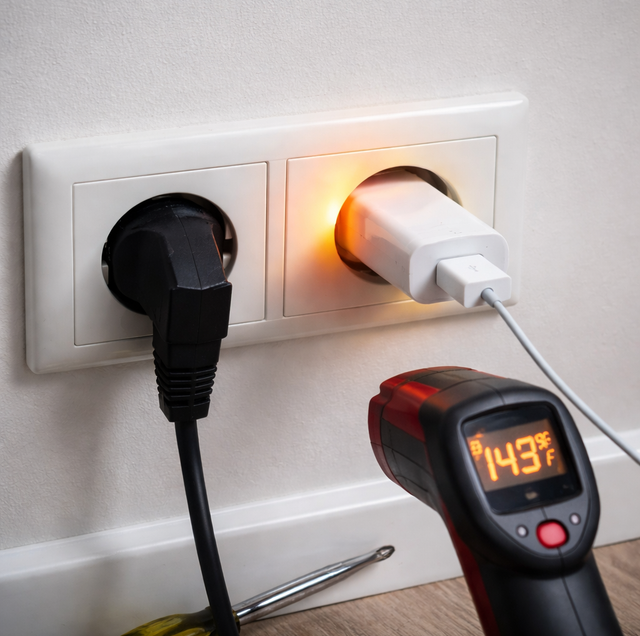
You go to unplug a phone charger, and the prongs are warm. Or you brush a hand across the wall, and the plastic faceplate feels warmer than the paint around it. Maybe it is the outlet behind the couch where a space heater has been running, and the cord plug is hot enough that you notice it. That warmth is information. Sometimes it means almost nothing, and sometimes it is the first sign of a connection that is slowly cooking itself inside the wall. Knowing which one you are looking at, and where the line sits between the two, is worth a few minutes of attention.
Electricity turns into heat wherever it meets resistance. A clean, tight connection carries current with almost no loss, so it stays cool. A poor connection acts like a narrow spot in a pipe: the same current has to force its way through a smaller path, and the metal right at that pinch point heats up. The effect climbs fast with current, because the heat generated at a bad joint rises with the square of the amperage flowing through it. Double the load through a loose terminal, and you roughly quadruple the heat it produces.
Inside a receptacle, current passes through several of these joints on its way to your appliance: the wire landing on the terminal, the internal metal of the device, and the spring contacts that grip the blades of your plug. Any one of them can become the weak link. That is the whole story behind a warm outlet, and every specific cause below is just a different version of resistance showing up somewhere it should not.
Why Heat Shows Up at an Outlet in the First Place
Not every warm outlet is a problem. A few things run mildly warm by design. A phone charger, a laptop brick, a modem, or any small power adapter plugged into the wall converts voltage and gives off a little heat as it works, so the device and the outlet around it can feel warm to the touch. A dimmer switch does the same, and a dimmer controlling a heavy lighting load runs warmest of all because it sheds energy as heat while it throttles the circuit.
The useful test is location, temperature, and whether anything is drawing power. Warmth you can rest a finger on comfortably, coming from a charger or a device that is actively working, is usually ordinary. What is not ordinary is a faceplate or receptacle too hot to hold for more than a second or two, warmth at an outlet with nothing plugged into it, any smell of hot plastic or fish, a buzzing or crackling sound, or brown discoloration and scorch marks around the slots. Those point to a fault at a connection, not the gentle heat of a working device. When in doubt, feel whether the heat is at the plug prongs of the appliance or at the wall itself. Heat concentrated at the outlet body is the one that deserves a closer look.
Normal Warmth Versus a Warning Sign
When the heat is real, a handful of causes account for almost all of it. They are worth knowing in rough order of how often they turn up.
A loose or backstabbed wire connection: This is the most common culprit. Many receptacles offer two ways to land a wire: wrapped under a screw terminal on the side, or pushed into a small spring-loaded hole on the back, called a backstab or push-in connection. The backstab relies on a thin metal blade pressing against a short length of bare wire, which is a much smaller contact area than a wire clamped under a screw. Over years of the metal warming and cooling with load, that grip relaxes, resistance climbs, and the connection heats. A wire that was never tightened fully under its screw does the same thing. This is why an electrician often moves wires off the backstabs and onto the screws when replacing a hot receptacle.
An overloaded circuit or a high-draw appliance: A portable space heater is the classic offender. A 1,500-watt heater pulls about 12.5 amps, which sits right near the ceiling of a standard 15-amp circuit, and it holds that draw continuously for hours. Feed that much steady current through an outlet with even a slightly imperfect connection and the joint has no chance to cool between surges. Window air conditioners, hair dryers, and space heaters run through cheap power strips create the same stress. The outlet is not necessarily faulty; it is being asked to pass more current than its weakest connection can handle without heating.
A worn receptacle with weak contacts: Inside every outlet, brass spring contacts grip the blades of whatever you plug in. On an inexpensive residential-grade receptacle, those contacts lose tension after enough insertions or enough years, and a loose grip lets tiny arcs jump between the blade and the contact each time current flows. That arcing heats the face of the outlet and is a big reason an old receptacle in a heavily used spot, a kitchen counter or a bedroom nightstand, starts running warm even under a modest load. Spec-grade and commercial receptacles use stiffer contacts that hold their grip far longer.
Aluminum wiring oxidizing at the terminal: Homes built in the late 1960s and 1970s often have aluminum branch-circuit wiring. Aluminum grows an insulating oxide layer where it is exposed, and it expands and contracts more than copper as it heats and cools, so a connection that was tight when installed can loosen and build resistance over time. On a standard outlet not rated for it, that combination is a known heat and fire risk, which is why the accepted fixes are receptacles marked CO/ALR or listed copper pigtails joined with the correct connector and an antioxidant compound.
A device that runs warm by nature: As covered above, chargers, power adapters, and dimmers give off some heat as part of doing their job. The distinction that matters is steady, mild warmth from an actively working device versus a receptacle that keeps getting hotter, especially one heating with nothing plugged in. The first is the appliance. The second is the wiring.
What Makes an Outlet Run Hot
This is the version that should get attention quickly. Most outlets are wired in a run, meaning the receptacle is a junction that current passes through on its way to other outlets further down the circuit. The connections on the back of a given outlet may be carrying current for a lamp or a television two rooms away, even when that particular outlet has nothing in it. So a loose or failing connection can heat the dead-looking outlet while a load elsewhere on the circuit is doing the work.
Because that heat is happening inside a closed plastic box in the wall, it can build for a long time before anyone notices. A loose connection does not just warm up; it can begin to arc across the tiny gap, and an arc runs far hotter than simple resistance, hot enough to melt the receptacle, char the surrounding wood, and start a fire in the wall cavity. That is the real hazard behind a hot outlet, and it is why an outlet that is warm with nothing plugged into it is not something to keep an eye on for a while. It is something to stop using and have looked at.
When an Outlet Is Hot With Nothing Plugged In
You do not need to diagnose it yourself, and you should not pull the outlet out of the wall. A few sensible steps lower the risk and get the right person the information they need. Unplug whatever is drawing power through that outlet, especially a space heater or air conditioner, since removing the load removes the heat. If the receptacle is hot, discolored, or smells like burning plastic, switch off the breaker that feeds it so the circuit is de-energized, then leave it off. Note which outlet it is and which other outlets or lights go dead when that breaker is off, because that tells an electrician how the circuit is wired and where the bad connection likely sits. Then call a licensed electrician and describe exactly what you felt, smelled, and heard. If you see smoke, sparking, or flame, get everyone away and call 911 first.
The repair itself is usually modest once the outlet is open. An electrician can move wires from failing backstabs onto the screw terminals torqued to spec, swap a worn receptacle for a spec-grade one, install CO/ALR-rated devices or copper pigtails where aluminum wiring is present, and confirm the box and wiring behind it were not already heat-damaged. Where the real problem is a circuit carrying more than it was built for, the answer may be a dedicated circuit for the heavy appliance rather than a new outlet.
What to Do When You Find a Hot Outlet
Sometimes the physical part is simple, but some traps make this riskier than it looks. If the home has aluminum wiring, a standard replacement receptacle is not rated for it and can make the hazard worse; it needs a CO/ALR device or a copper pigtail. If the heat came from a loose backstab, simply reusing the push-in holes on the new outlet repeats the mistake. And if the box or wire insulation is already scorched, the damage may run past the receptacle itself. On top of that, the circuit has to be positively de-energized at the panel, not just switched off at the outlet, before anyone opens it.
Frequently Asked Questions
It depends on how warm and what is plugged in. If a charger or a working device is making it mildly warm and nothing smells or sounds off, you can generally keep going and schedule a visit. If the outlet is hot enough that you cannot hold a finger on it, if it is warm with nothing plugged in, or if there is any smell of hot plastic, buzzing, or discoloration, stop using it and shut off its breaker. The failure that matters here is a series connection quietly arcing inside the wall, and that one gets worse the longer current runs through it.
Feel the plug prongs of the appliance and the wall faceplate separately. If the cord and its plug are hot but the faceplate is close to room temperature, the trouble is usually in the appliance, its cord, or an undersized extension cord, not the outlet. If the faceplate and receptacle body are hot regardless of what is plugged in, or hot with nothing plugged in, the connection at the wall is the suspect. A cheap power strip or a coiled extension cord under a rug is its own overheating risk and is worth ruling out early.
Sometimes the physical part is simple, but some traps make this riskier than it looks. If the home has aluminum wiring, a standard replacement receptacle is not rated for it and can make the hazard worse; it needs a CO/ALR device or a copper pigtail. If the heat came from a loose backstab, simply reusing the push-in holes on the new outlet repeats the mistake. And if the box or wire insulation is already scorched, the damage may run past the receptacle itself. On top of that, the circuit has to be positively de-energized at the panel, not just switched off at the outlet, before anyone opens it.
A little more, and some warmth is normal for them. A USB or USB-C receptacle has a small power supply built in that converts 120 volts down to 5 volts or so, and that conversion gives off heat whenever a device is charging, so the faceplate can feel warmer than a plain outlet. Smart outlets with built-in relays and radios do the same on a smaller scale. Mild warmth while charging is expected. A hot USB outlet that has stopped charging reliably, or that smells of hot electronics, is a different matter, because the internal components have likely failed and the whole device should be replaced.
That points to how the circuit is chained together. Outlets on a branch circuit are usually wired one to the next, so current for a downstream outlet flows through the terminals of the ones before it. If a lamp or an appliance in one room heats up a seemingly unrelated outlet in another, the loose or corroded connection is almost certainly at the outlet that gets hot, and it is carrying the load headed further down the line. Noting which outlet heats up and which load triggers it is especially useful for finding the bad joint fast.
Not necessarily, because they watch for different things. A GFCI trips when current leaks to ground, which protects you from shock, but it does not react to a hot connection that is passing its current normally along the wire. An AFCI breaker is designed to catch certain arcing faults and can help, though a slowly worsening loose terminal that heats without a clear arc signature does not always trip one. Neither device is a substitute for fixing the connection. They are protection layers, not a reason to leave a warm outlet in service.
If an outlet feels hot or is warm with nothing plugged in — have a licensed electrician track down the connection before it damages the wiring, because a hot outlet is usually a fixable fault when it is caught early. Rojas Electric serves Fairfax and all of Northern Virginia. Call (703) 810-3693.
