
Plugging a Generator Into a Wall Outlet: Why It Can Kill
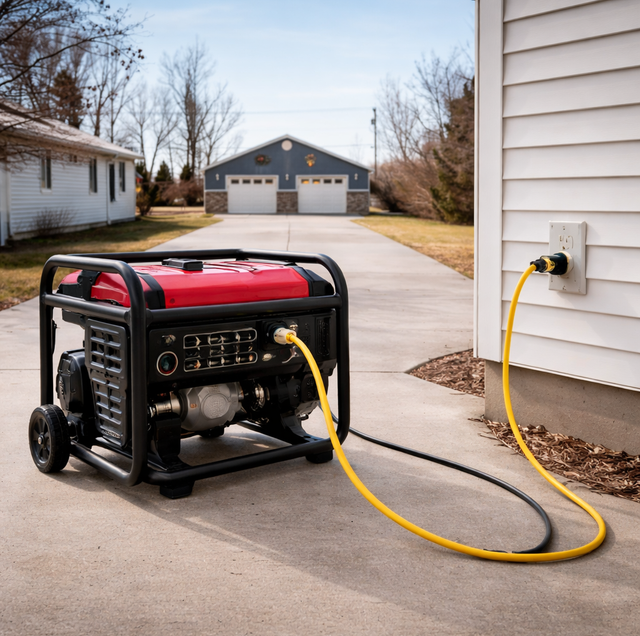
The power goes out during a storm, the portable generator is running in the driveway, and someone remembers a shortcut they heard about: run a cord from the generator into a regular wall outlet, or the dryer outlet, and the whole house comes back to life. The cord that makes it work has a plug molded onto both ends, so it can go generator-to-outlet. In the trade, it has a grim nickname, the "suicide cord," and the name is not an exaggeration. Feeding power backward into your home through an outlet is one of the few electrical mistakes that can kill someone you will never meet, and it can destroy the generator you were trying to protect. Here is what actually happens on that connection, and the connections a licensed electrician installs instead.
What "Backfeeding" Actually Does to Your Wiring
A wall outlet is designed for power to flow one direction: out of the panel, through the branch circuit, into whatever you plug in. Plug a generator into that same outlet, and you reverse the flow. Power now travels backward through the branch circuit to the panel bus, and from that bus it energizes every circuit in the house at once. That part alone is a problem, because there is no switch separating your house from the utility. So the current does not stop at your walls. It keeps flowing backward out through the main breaker, through the meter, and onto the utility service line feeding your street.
This is the core danger, and it is worth being precise about. Under normal conditions, the transformer on the pole or pad outside your home steps the utility's high distribution voltage down to the 120 and 240 volts your house uses. Feed voltage backward into it and that transformer runs in reverse. It steps your generator's 120/240 volts back UP to thousands of volts on the primary line, the same distribution voltage it normally steps down.
The Person Your Backfeed Can Reach
During an outage, utility crews work on lines they have every reason to believe are dead. A lineworker restoring your neighborhood may be handling a wire that a backfeeding generator has re-energized to full stepped-up distribution voltage. There is no warning, and the crew has no way to know one house on the block turned a downed line back into a live one. The same energized line can reach neighbors served by the same transformer.
A single generator backfeeding through a wall outlet can put lethal distribution voltage back onto utility lines that crews and neighbors believe are de-energized. This is the reason the practice is banned, not a formality. Isolation from the utility is the entire point of a proper connection.
That is why every safe method described below does one thing above all else: it physically prevents your generator and the utility from ever being connected at the same time.
No Breaker Is Watching That Connection
There is a second failure hiding in the same cord. When you plug a generator into an outlet, the current feeding your house is no longer passing through a breaker sized to protect it in that direction. A branch circuit breaker trips when too much current flows out to a load. Run power backward, and you have handed the generator's output to the house wiring with no overcurrent device positioned to catch an overload on that path. Draw too much and the weak link, often the cord itself, overheats before anything trips.
The cord is a hazard even before you overload it. A double-male cord has exposed metal prongs on whichever end is not plugged in yet, and the moment the generator runs, those prongs are live. Anyone who brushes them- a curious child, a helping neighbor, you in the dark- contacts full generator voltage directly. A standard 120-volt outlet also only connects to one of the two legs (busbars) in your panel, so a backfeed through it energizes half your circuits unpredictably while still feeding the grid. It is both dangerous and a poor way to power a house.
When the Grid Comes Back, It Fights Your Generator
Say you avoid every shock. There is still the moment the utility restores power. Your generator and the grid are two separate sources, and they are not synchronized: their voltage waveforms are almost certainly out of phase, and their frequencies do not match. When utility power returns to a house that is still backfeeding, those two mismatched sources are suddenly tied together. The grid, effectively infinite next to a portable generator, slams the smaller machine into line. That collision can wreck the generator's alternator windings, and the voltage spikes and surges ride through your home and can damage motors, electronics, and appliances on the way. The setup that was supposed to ride out the outage can become its own repair bill the instant the lights would have come back on their own.
The Safe Ways to Connect a Generator
Every legitimate method solves the same problem: it isolates your home from the utility so power can never flow back onto the grid, and it gives the generator a proper, enclosed connection with no exposed prongs. An electrician sizes and installs the right one for your panel and your loads.
A transfer switch: This is the most complete solution. A transfer switch sits at or beside your panel and lets your house draw from either the utility or the generator, never both. A manual transfer switch has you throw it by hand when the power fails; an automatic transfer switch, the kind paired with a permanently installed standby generator, senses the outage, starts the unit, and switches selected circuits over within seconds, then switches back and shuts it down when the grid returns. Many are wired to a small subpanel of critical circuits, so the loads that matter during an outage are decided in advance.
A breaker interlock kit: For a portable generator, an interlock kit is a listed, lower-effort path that many panels can accept. It is a metal plate that mounts over the breakers so that the main breaker and a dedicated generator breaker can never be switched on at the same time. To use the generator, you turn the main off, which mechanically frees the generator breaker to turn on. Because the two cannot both be energized, backfeed to the utility is impossible. It gives you access to any circuit in the panel, with the tradeoff that you manage the load yourself rather than having circuits preselected.
A dedicated generator inlet box: Whichever switching method you use, the generator connects to the house through an exterior power inlet box, a weatherproof fitting mounted on an outside wall. You run a proper generator cord from the machine to the inlet, commonly an L14-30 cord: a four-wire, 30-amp, 125/250-volt twist-lock cord carrying two hot legs, a neutral, and a ground. The twist-lock ends lock in place so vibration cannot shake them loose, and every connector is enclosed, so there is never a live exposed prong anywhere in the setup. The inlet also keeps the generator itself outdoors where it belongs, feeding the panel through one clean, code-recognized connection.
What a Sound Setup Comes Down To
The appeal of the wall-outlet shortcut is understandable: the equipment is cheap, and in the moment it looks like it works. What it skips is the one feature that makes generator power safe: a hard separation between your house and the grid, plus overcurrent protection and enclosed connectors. A transfer switch or an interlock kit paired with an inlet box builds that separation in permanently, so you can power your home in an outage without gambling on a lineworker's life or your own. It is permitted and inspected work, and the switching method is matched to your panel and the circuits you actually need to keep running.
Frequently Asked Questions
Turning the main off is the exact rationalization that gets people hurt, because it relies on memory and habit rather than hardware. Forget one time, or let someone reset the main while the generator runs, and you are backfeeding the grid again. Even done perfectly, it leaves the other problems in place: no overcurrent device protects the cord, the double-male prongs are still live, and a 120-volt outlet still only energizes one leg of the panel. An interlock kit makes the "main off" step mechanical and automatic, which is the whole reason it is a recognized method and a loose cord is not.
L14-30 describes a specific twist-lock connector: "L" for locking, 30 for 30 amps, and a four-wire configuration of two hots, a neutral, and a ground rated for 125/250 volts. It matches the 240-volt outlet on many portable generators in the 7,500-watt class, which is a common size for backing up a home's essentials. Larger units or whole-panel setups may use a higher-rated inlet and cord, and small generators with only 120-volt outlets cannot properly feed a 240-volt panel at all. An electrician sizes the inlet, cord, and breaker to the generator you own.
No. A GFCI protects against a ground fault, current leaking off the circuit through a person, or a wet fault on the load side of that outlet. It has nothing to do with power flowing backward out to the utility, and it will not sense or stop a backfeed onto the service line. The panel breakers are positioned to protect circuits feeding loads, not to police a reverse feed coming in through a receptacle. None of the built-in protections in your home are designed for the direction backfeeding sends the current.
Only if the generator is large enough, which a portable usually is not. The point of both is to power selected circuits safely, not to run everything at once. A transfer switch is often wired to a critical-loads subpanel decided in advance: refrigerator, furnace blower, some lights, internet, a medical device. An interlock kit lets you reach any breaker in the panel but leaves the balancing to you, so you switch off heavy loads like central air or an electric range and manage what runs at any moment. Sizing the generator to the loads is where these projects succeed or stall.
Well outside and away from the building, never in a garage, breezeway, or against an open window, because the real hidden killer in an outage is carbon monoxide from the engine exhaust, not just the electricity. CO is colorless and odorless and has taken lives in homes where a generator ran too close. An inlet box actually helps here: it lets the generator stay far out in the yard on its cord while a single enclosed connection feeds the panel, instead of tempting anyone to move the machine closer to reach an outlet.
The isolation principle is the same, though the equipment differs. A permanently installed standby generator uses an automatic transfer switch that starts and switches without you touching anything. A home battery does the same job through its own inverter and gateway, which disconnects from the grid the instant it takes over. If you start with a portable generator and an interlock or manual transfer switch, you have already invested in the correct backbone, the hard separation from the utility, and an electrician can build on it when you move to an automatic system.
Have a generator connection installed the safe way — a transfer switch, interlock kit, or inlet box sized to your panel and the circuits you need. Rojas Electric serves Fairfax and all of Northern Virginia. Call (703) 810-3693.
